|
MY LADY NICOTINE
A Study in Smoke 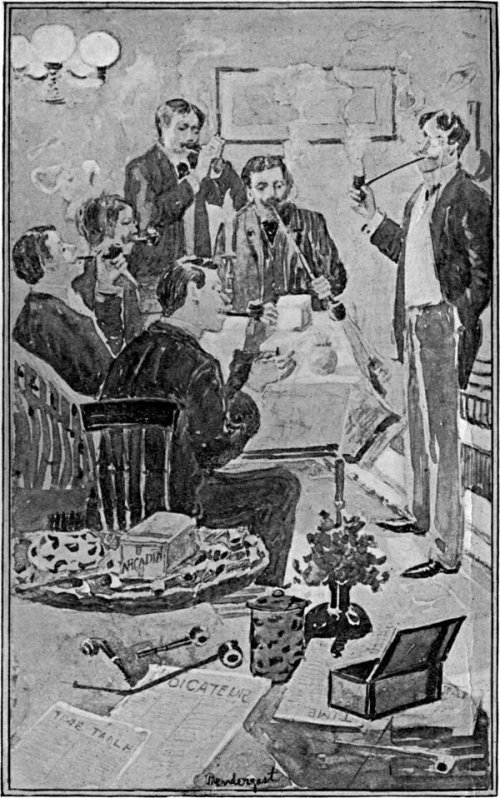
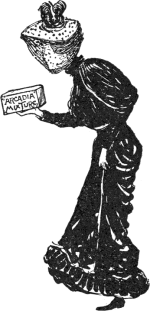
CHAPTER I.MATRIMONY AND SMOKING COMPARED.The circumstances in which I gave up smoking were these: I was a mere bachelor, drifting toward what I now see to be a tragic middle age. I had become so accustomed to smoke issuing from my mouth that I felt incomplete without it; indeed, the time came when I could refrain from smoking if doing nothing else, but hardly during the hours of toil. To lay aside my pipe was to find myself soon afterward wandering restlessly round my table. No blind beggar was ever more abjectly led by his dog, or more loath to cut the string. [pg 2] I am much better without tobacco, and already have a difficulty in sympathizing with the man I used to be. Even to call him up, as it were, and regard him without prejudice is a difficult task, for we forget the old selves on whom we have turned our backs, as we forget a street that has been reconstructed. Does the freed slave always shiver at the crack of a whip? I fancy not, for I recall but dimly, and without acute suffering, the horrors of my smoking days. There were nights when I awoke with a pain at my heart that made me hold my breath. I did not dare move. After perhaps ten minutes of dread, I would shift my position an inch at a time. Less frequently I felt this sting in the daytime, and believed I was dying while my friends were talking to me. I never mentioned these experiences to a human being; indeed, though a medical man was among my companions, I cunningly deceived him on the rare occasions when he questioned me about the amount of tobacco I was consuming weekly. Often in the dark I not only vowed to give up smoking, but wondered why I cared for it. Next morning I went straight from breakfast to my pipe, without the smallest struggle with myself. Latterly I knew, while resolving to break myself of the habit, that I would be better [pg 3] employed trying to sleep. I had elaborate ways of cheating myself, but it became disagreeable to me to know how many ounces of tobacco I was smoking weekly. Often I smoked cigarettes to reduce the number of my cigars. On the other hand, if these sharp pains be excepted, I felt quite well. My appetite was as good as it is now, and I worked as cheerfully and certainly harder. To some slight extent, I believe, I experienced the same pains in my boyhood, before I smoked, and I am not an absolute stranger to them yet. They were most frequent in my smoking days, but I have no other reason for charging them to tobacco. Possibly a doctor who was himself a smoker would have pooh-poohed them. Nevertheless, I have lighted my pipe, and then, as I may say, hearkened for them. At the first intimation that they were coming I laid the pipe down and ceased to smoke—until they had passed. I will not admit that, once sure it was doing me harm, I could not, unaided, have given up tobacco. But I was reluctant to make sure. I should like to say that I left off smoking because I considered it a mean form of slavery, to be condemned for moral as well as physical reasons; but though now I clearly see the folly of smoking, I was blind to it for some months [pg 4] after I had smoked my last pipe. I gave up my most delightful solace, as I regarded it, for no other reason than that the lady who was willing to fling herself away on me said that I must choose between it and her. This deferred our marriage for six months. I have now come, as those who read will see, to look upon smoking with my wife's eyes. My old bachelor friends complain because I do not allow smoking in the house, but I am always ready to explain my position, and I have not an atom of pity for them. If I cannot smoke here neither shall they. When I visit them in the old inn they take a poor revenge by blowing rings of smoke almost in my face. This ambition to blow rings is the most ignoble known to man. Once I was a member of a club for smokers, where we practised blowing rings. The most successful got a box of cigars as a prize at the end of the year. Those were days! Often I think wistfully of them. We met in a cozy room off the Strand. How well I can picture it still. Time-tables lying everywhere, with which we could light our pipes. Some smoked clays, but for the Arcadia Mixture give me a brier. My brier was the sweetest ever known. It is strange now to recall a time when a pipe seemed to be my best friend. [pg 5] My present state is so happy that I can only look back with wonder at my hesitation to enter upon it. Our house was taken while I was still arguing that it would be dangerous to break myself of smoking all at once. At that time my ideal of married life was not what it is now, and I remember Jimmy's persuading me to fix on this house, because the large room upstairs with the three windows was a smoker's dream. He pictured himself and me there in the summer-time blowing rings, with our coats off and our feet out at the windows; and he said that the closet at the back looking on to a blank wall would make a charming drawing-room for my wife. For the moment his enthusiasm carried me away, but I see now how selfish it was, and I have before me the face of Jimmy when he paid us his first visit and found that the closet was not the drawing-room. Jimmy is a fair specimen of a man, not without parts, destroyed by devotion to his pipe. To this day he thinks that mantelpiece vases are meant for holding pipe-lights in. We are almost certain that when he stays with us he smokes in his bedroom—a detestable practice that I cannot permit.
Two cigars a day at ninepence apiece come to £27 7s. 6d. yearly,
and four ounces of tobacco a week at nine shillings a pound come to
[pg 6]
The very smell of tobacco is abominable, for one cannot get it out of the curtains, and there is little pleasure in existence unless the curtains are all right. As for a cigar after dinner, it only makes you dull and sleepy and disinclined for ladies' society. A far more delightful way of spending the evening is to go straight from dinner to the drawing-room and have a little music. It calms the mind to listen to your wife's niece singing, "Oh, that we two were Maying!" Even if you are not musical, as is the case with me, there is a great deal in the drawing-room to refresh you. There are the Japanese fans on the wall, which are things of beauty, though your artistic taste may not be [pg 8] sufficiently educated to let you know it except by hearsay; and it is pleasant to feel that they were bought with money which, in the foolish old days, would have been squandered on a box of cigars. In like manner every pretty trifle in the room reminds you how much wiser you are now than you used to be. It is even gratifying to stand in summer at the drawing-room window and watch the very cabbies passing with cigars in their mouths. At the same time, if I had the making of the laws I would prohibit people's smoking in the street. If they are married men, they are smoking drawing-room fire-screens and mantelpiece borders for the pink-and-gold room. If they are bachelors, it is a scandal that bachelors should get the best of everything. Nothing is more pitiable than the way some men of my acquaintance enslave themselves to tobacco. Nay, worse, they make an idol of some one particular tobacco. I know a man who considers a certain mixture so superior to all others that he will walk three miles for it. Surely every one will admit that this is lamentable. It is not even a good mixture, for I used to try it occasionally; and if there is one man in London who knows tobaccoes it is myself. There [pg 9] is only one mixture in London deserving the adjective superb. I will not say where it is to be got, for the result would certainly be that many foolish men would smoke more than ever; but I never knew anything to compare to it. It is deliciously mild yet full of fragrance, and it never burns the tongue. If you try it once you smoke it ever afterward. It clears the brain and soothes the temper. When I went away for a holiday anywhere I took as much of that exquisite health-giving mixture as I thought would last me the whole time, but I always ran out of it. Then I telegraphed to London for more, and was miserable until it arrived. How I tore the lid off the canister! That is a tobacco to live for. But I am better without it. Occasionally I feel a little depressed after dinner still, without being able to say why, and if my wife has left me, I wander about the room restlessly, like one who misses something. Usually, however, she takes me with her to the drawing-room, and reads aloud her delightfully long home-letters or plays soft music to me. If the music be sweet and sad it takes me away to a stair in an inn, which I climb gayly, and shake open a heavy door on the top floor, and turn up the gas. It is a little room I am in once again, and very dusty. A pile of papers [pg 10] and magazines stands as high as a table in the corner furthest from the door. The cane chair shows the exact shape of Marriot's back. What is left (after lighting the fire) of a frame picture lies on the hearth-rug. Gilray walks in uninvited. He has left word that his visitors are to be sent on to me. The room fills. My hand feels along the mantelpiece for a brown jar. The jar is between my knees; I fill my pipe.... After a time the music ceases, and my wife puts her hand on my shoulder. Perhaps I start a little, and then she says I have been asleep. This is the book of my dreams. 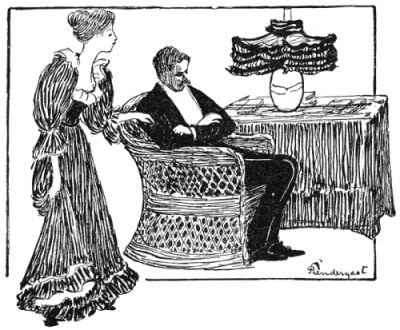
CHAPTER II.MY FIRST CIGAR.
It was not in my chambers, but three hundred miles further north, that I learned to smoke. I think I may say with confidence that a first cigar was never smoked in such circumstances before. At that time I was a school-boy, living with my brother, who was a man. People mistook our relations, and thought I was his son. They would ask me how my father was, and when he heard of this he scowled at me. Even to this day I look so young that people who remember me as a boy now think I must be that boy's younger brother. I shall tell presently of a strange mistake of this kind, but at present I am thinking of the evening when my brother's eldest daughter was born—perhaps the most trying evening he and I ever passed together. So far as I knew, the affair was very sudden, [pg 12] and I felt sorry for my brother as well as for myself.
We sat together in the study, he on an arm-chair drawn near the fire and
I on the couch. I cannot say now at what time I began to have an inkling
that there was something wrong. It came upon me gradually and made
me very uncomfortable, though of course I did not show this. I heard
people going up and down stairs, but I was not at that time naturally
suspicious. Comparatively early in the evening I felt that my brother
had something on his mind. As a rule, when we were left together, he
yawned or drummed with his fingers on the arm of his chair to show that
he did not feel uncomfortable, or I made a pretence of being at ease by
playing with the dog or saying that the room was close. Then one of us
would rise, remark that he had left his book in the dining-room, and
go away to look for it, taking care not to come back till the other
had gone. In this crafty way we helped each other. On that occasion,
however, he did not adopt any of the usual methods, and though I went
up to my bedroom several times and listened through the wall, I heard
nothing. At last some one told me not to go upstairs, and I returned
to the study, feeling that I now knew the worst. He
[pg 13]
was still in the
arm-chair, and I again took to the couch. I could see by the way he
looked at me over his pipe that he was wondering whether I knew
anything. I don't think I ever liked my brother better than on that
night; and I wanted him to understand that, whatever happened, it would
make no difference between us. But the affair upstairs was too delicate
to talk of, and all I could do was to try to keep his mind from brooding
on it, by making him tell me things about politics. This is the kind of
man my brother is. He is an astonishing master of facts, and I suppose
he never read a book yet, from a Blue Book to a volume of verse,
without catching the author in error about something. He reads books
for that purpose. As a rule I avoided argument with him, because he was
disappointed if I was right and stormed if I was wrong. It was therefore
a dangerous thing to begin on politics, but I thought the circumstances
warranted it. To my surprise he answered me in a rambling manner,
occasionally breaking off in the middle of a sentence and seeming to
listen for something. I tried him on history, and mentioned 1822 as the
date of the battle of Waterloo, merely to give him his opportunity. But
he let it pass. After that there was silence. By and by he
[pg 14]
In a little while he came back. He found me reading. He lighted his pipe and pretended to read too. I shall never forget that my book was "Anne Judge, Spinster," while his was a volume of "Blackwood." Every five minutes his pipe went out, and sometimes [pg 15] the book lay neglected on his knee as he stared at the fire. Then he would go out for five minutes and come back again. It was late now, and I felt that I should like to go to my bedroom and lock myself in. That, however, would have been selfish; so we sat on defiantly. At last he started from his chair as some one knocked at the door. I heard several people talking, and then loud above their voices a younger one. 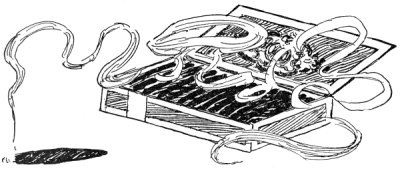
When I came to myself, the first thing I thought was that they would ask me to hold it. Then I remembered, with another sinking at the heart, that they might want to call it after me. These, of course, were selfish reflections; but my position was a trying one. The question was, what was the proper thing for me to do? I told myself that my brother might come back at any moment, and all I thought of after that was what I should say to him. I had an [pg 16] idea that I ought to congratulate him, but it seemed a brutal thing to do. I had not made up my mind when I heard him coming down. He was laughing and joking in what seemed to me a flippant kind of way, considering the circumstances. When his hand touched the door I snatched at my book and read as hard as I could. He was swaggering a little as he entered, but the swagger went out of him as soon as his eye fell on me. I fancy he had come down to tell me, and now he did not know how to begin. He walked up and down the room restlessly, looking at me as he walked the one way, while I looked at him as he walked the other way. At length he sat down again and took up his book. He did not try to smoke. The silence was something terrible; nothing was to be heard but an occasional cinder falling from the grate. This lasted, I should say, for twenty minutes, and then he closed his book and flung it on the table. I saw that the game was up, and closed "Anne Judge, Spinster." Then he said, with affected jocularity: "Well, young man, do you know that you are an uncle?" There was silence again, for I was still trying to think out some appropriate remark. After a time I said, in a weak voice. "Boy or girl?" "Girl," he answered. Then [pg 17] I thought hard again, and all at once remembered something. "Both doing well?" I whispered. "Yes," he said sternly. I felt that something great was expected of me, but I could not jump up and wring his hand. I was an uncle. I stretched out my arm toward the cigar-box, and firmly lighted my first cigar. 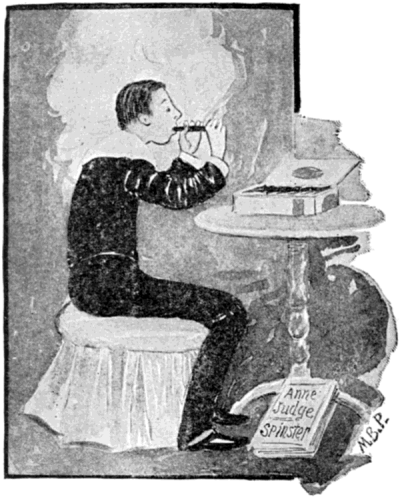
CHAPTER III.THE ARCADIA MIXTURE.
Darkness comes, and with it the porter to light our stair gas. He vanishes into his box. Already the inn is so quiet that the tap of a pipe on a window-sill startles all the sparrows in the quadrangle. The men on my stair emerged from their holes. Scrymgeour, in a dressing-gown, pushes open the door of the boudoir on the first floor, and climbs lazily. The sentimental face and the clay with a crack in it are Marriot's. Gilray, who has been rehearsing his part in the new original comedy from the Icelandic, ceases muttering and feels his way along his dark lobby. Jimmy pins a notice on his door, "Called away on business," [pg 19] and crosses to me. Soon we are all in the old room again, Jimmy on the hearth-rug, Marriot in the cane chair; the curtains are pinned together with a pen-nib, and the five of us are smoking the Arcadia Mixture. Pettigrew will be welcomed if he comes, but he is a married man, and we seldom see him nowadays. Others will be regarded as intruders. If they are smoking common tobaccoes, they must either be allowed to try ours or requested to withdraw. One need only put his head in at my door to realize that tobaccoes are of two kinds, the Arcadia and others. No one who smokes the Arcadia would ever attempt to describe its delights, for his pipe would be certain to go out. When he was at school, Jimmy Moggridge smoked a cane chair, and he has since said that from cane to ordinary mixtures was not so noticeable as the change from ordinary mixtures to the Arcadia. I ask no one to believe this, for the confirmed smoker in Arcadia detests arguing with anybody about anything. Were I anxious to prove Jimmy's statement, I would merely give you the only address at which the Arcadia is to be had. But that I will not do. It would be as rash as proposing a man with whom I am unacquainted for my club. You may not be worthy to smoke the Arcadia Mixture.
[pg 20]
If you meet in company a man who has ideas and is not shy, yet refuses
absolutely to be drawn into talk, you may set him down as one
I willingly gibbet myself to show how reticent the Arcadia makes us. It happens that I have [pg 22] a connection with Nottingham, and whenever a man mentions Nottingham to me, with a certain gleam in his eye, I know that he wants to discuss the lace trade. But it is a curious fact that the aggressive talker constantly mixes up Nottingham and Northampton. "Oh, you know Nottingham," he says, interestedly; "and how do you like Labouchere for a member?" Do you think I put him right? Do you imagine me thirsting to tell that Mr. Labouchere is the Christian member for Northampton? Do you suppose me swift to explain that Mr. Broadhurst is one of the Nottingham members, and that the "Nottingham lambs" are notorious in the history of political elections? Do you fancy me explaining that he is quite right in saying that Nottingham has a large market-place? Do you see me drawn into half an hour's talk about Robin Hood? That is not my way. I merely reply that we like Mr. Labouchere pretty well. It may be said that I gain nothing by this; that the talker will be as curious about Northampton as he would have been about Nottingham, and that Bradlaugh and Labouchere and boots will serve his turn quite as well as Broadhurst and lace and Robin Hood. But that is not so. Beginning on Northampton in the most confident manner, it suddenly flashes across him that [pg 23] he has mistaken Northampton for Nottingham. "How foolish of me!" he says. I maintain a severe silence. He is annoyed. My experience of talkers tells me that nothing annoys them so much as a blunder of this kind. From the coldly polite way in which I have taken the talker's remarks, he discovers the value I put upon them, and after that, if he has a neighbor on the other side, he leaves me alone. Enough has been said to show that the Arcadian's golden rule is to be careful about what he says. This does not mean that he is to say nothing. As society is at present constituted you are bound to make an occasional remark. But you need not make it rashly. It has been said somewhere that it would be well for talkative persons to count twenty, or to go over the alphabet, before they let fall the observation that trembles on their lips. The non-talker has no taste for such an unintellectual exercise. At the same time he must not hesitate too long, for, of course, it is to his advantage to introduce the subject. He ought to think out a topic of which his neighbor will not be able to make very much. To begin on the fall of snow, or the number of tons of turkeys consumed on Christmas Day, as stated in the Daily Telegraph, is to deserve your fate. If you are at a dinner-party [pg 24] of men only, take your host aside, and in a few well-considered sentences find out from him what kind of men you are to sit between during dinner. Perhaps one of them is an African traveller. A knowledge of this prevents your playing into his hands, by remarking that the papers are full of the relief of Emin Pasha. These private inquiries will also save you from talking about Mr. Chamberlain to a neighbor who turns out to be the son of a Birmingham elector. Allow that man his chance, and he will not only give you the Birmingham gossip, but what individual electors said about Mr. Chamberlain to the banker or the tailor, and what the grocer did the moment the poll was declared, with particulars about the antiquity of Birmingham and the fishing to be had in the neighborhood. What you ought to do is to talk about Emin Pasha to this man, and to the traveller about Mr. Chamberlain, taking care, of course, to speak in a low voice. In that way you may have comparative peace. Everything, however, depends on the calibre of your neighbors. If they agree to look upon you as an honorable antagonist, and so to fight fair, the victory will be to him who deserves it; that is to say, to the craftier man of the two. But talkers, as a rule, do not fight fair. They consider [pg 25] silent men their prey. It will thus be seen that I distinguish between talkers, admitting that some of them are worse than others. The lowest in the social scale is he who stabs you in the back, as it were, instead of crossing swords. If one of the gentlemen introduced to you is of that type, he will not be ashamed to say, "Speaking of Emin Pasha, I wonder if Mr. Chamberlain is interested in the relief expedition. I don't know if I told you that my father——" and there he is, fairly on horseback. It is seldom of any use to tempt him into other channels. Better turn to your traveller and let him describe the different routes to Egyptian Equatorial Provinces, with his own views thereon. Allow him even to draw a map of Africa with a fork on the table-cloth. A talker of this kind is too full of his subject to insist upon answering questions, so that he does not trouble you much. It is his own dinner that is spoiled rather than yours. Treat in the same way as the Chamberlain talker the man who sits down beside you and begins, "Remarkable man, Mr. Gladstone." There was a ventilator in my room, which sometimes said "Crik-crik!" reminding us that no one had spoken for an hour. Occasionally, however, we had lapses of speech, when Gilray [pg 26] might tell over again—though not quite as I mean to tell it—the story of his first pipeful of the Arcadia, or Scrymgeour, the travelled man, would give us the list of famous places in Europe where he had smoked. But, as a rule, none of us paid much attention to what the others said, and after the last pipe the room emptied—unless Marriot insisted on staying behind to bore me with his scruples—by first one and then another putting his pipe into his pocket and walking silently out of the room. 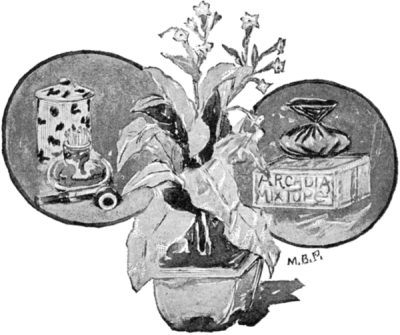
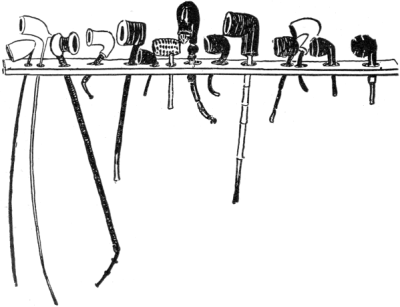
CHAPTER IV.MY PIPES.In a select company of scoffers my brier was known as the Mermaid. The mouth-piece was a cigarette-holder, and months of unwearied practice were required before you found the angle at which the bowl did not drop off.
Journeying back into the past, I come to a time when my pipe had a mouth-piece of fine amber. The bowl and the rest of the stem were of brier, but it was a gentlemanly pipe, without silver mountings. Such tobacco I revelled in as may have filled the pouch of Pan as he lay smoking on the mountain-sides. Once I saw a beautiful woman with brown hair, in and out of which the rays of a morning sun played hide-and-seek, that might not unworthily have been compared to it. Beguiled by the exquisite Arcadia, the days and the years passed from me in delicate rings of smoke, and I contentedly watched them sailing to the skies. How continuous was the line of those lovely circles, and how straight! One could have passed an iron rod through them from end to end. But one day I had a harsh awakening. I bit the amber mouth-piece of my pipe through, and life was never the same again. It is strange how attached we become to old friends, though they be but inanimate objects. The old pipe put aside, I turned to a meerschaum, which had been presented to me years before, with the caution that I must not smoke it unless I wore kid gloves. There was no savor [pg 30] in that pipe for me. I tried another brier, and it made me unhappy. Clays would not keep in with me. It seemed as if they knew I was hankering after the old pipe, and went out in disgust. Then I got a new amber mouth-piece for my first love. In a week I had bitten that through too, and in an over-anxious attempt to file off the ragged edges I broke the screw. Moralists have said that the smoker who has no thought but for his pipe never breaks it; that it is he only who while smoking concentrates his mind on some less worthy object that sends his teeth through the amber. This may be so; for I am a philosopher, and when working out new theories I may have been careless even of that which inspired them most. After this second accident nothing went well with me or with my pipe. I took the mouthpieces out of other pipes and fixed them on to the Mermaid. In a little while one of them became too wide; another broke as I was screwing it more firmly in. Then the bowl cracked at the rim and split at the bottom. This was an annoyance until I found out what was wrong and plugged up the fissures with sealing-wax. The wax melted and dropped upon my clothes after a time; but it was easily renewed. It was now that I had the happy thought of [pg 31] bringing a cigarette-holder to my assistance. But of course one cannot make a pipe-stem out of a cigarette-holder all at once. The thread you wind round the screw has a disappointing way of coming undone, when down falls the bowl, with an escape of sparks. Twisting a piece of paper round the screw is an improvement; but, until you have acquired the knack, the operation has to be renewed every time you relight your pipe. This involves a sad loss of time, and in my case it afforded a butt for the dull wit of visitors. Otherwise I found it satisfactory, and I was soon astonishingly adept at making paper screws. Eventually my brier became as serviceable as formerly, though not, perhaps, so handsome. I fastened on the holder with sealing-wax, and often a week passed without my having to renew the joint. It was no easy matter lighting a pipe like mine, especially when I had no matches. I always meant to buy a number of boxes, but somehow I put off doing it. Occasionally I found a box of vestas on my mantelpiece, which some caller had left there by mistake, or sympathizing, perhaps, with my case; but they were such a novelty that I never felt quite at home with them. Generally I remembered they were there just after my pipe was lighted.
[pg 32]
When I kept them in mind and looked forward to using them, they were
at the other side of the room, and it would have been a pity to get
up for them. Besides, the most convenient medium for lighting one's
pipe is paper, after all; and if you have not an old envelope in your
pocket, there is probably a photograph standing on the mantelpiece.
It is convenient to have the magazines lying handy; or a page from a
book—hand-made paper burns beautifully—will do. To be sure, there is
the lighting of your paper. For this your lamp is practically useless,
standing in the middle of the table, while you are in an easy-chair
by the fireside; and as for the tape-and-spark contrivance, it is the
introduction of machinery into the softest joys of life. The fire is
best. It is near you, and you drop your burning spill into it with a
minimum waste of energy. The proper fire for pipes is one in a cheerful
blaze. If your spill is carelessly constructed the flame runs up into
your fingers before you know what you are doing, so that it is as well
to marry and get your wife to make spills for you. Before you begin to
smoke, scatter these about the fireplace. Then you will be able to reach
them without rising. The irritating fire is the one that has burned
low—when the coals are more than half cinders, and
[pg 33]
No pipe really ever rivalled the brier in my affections, though I can recall a mad month when I fell in love with two little meerschaums, which I christened Romulus and Remus. They lay together in one case in Regent Street, and it was with difficulty that I could pass [pg 34] the shop without going in. Often I took side streets to escape their glances, but at last I asked the price. It startled me, and I hurried home to the brier. I forget when it was that a sort of compromise struck me. This was that I should present the pipes to my brother as a birthday gift. Did I really mean to do this, or was I only trying to cheat my conscience? Who can tell? I hurried again into Regent Street. There they were, more beautiful than ever. I hovered about the shop for quite half an hour that day. My indecision and vacillation were pitiful. Buttoning up my coat, I would rush from the window, only to find myself back again in five minutes. Sometimes I had my hand on the shop door. Then I tore it away and hurried into Oxford Street. Then I slunk back again. Self whispered, "Buy them—for your brother." Conscience said, "Go home." At last I braced myself up for a magnificent effort, and jumped into a 'bus bound for London Bridge. This saved me for the time.
I now began to calculate how I could become owner of the
meerschaums—prior to dispatching them by parcel-post to my
brother—without paying for them. That was my way of putting it.
I calculated that by giving up my daily
[pg 35]
paper I should save thirteen
shillings in six months. After all, why should I take in a daily paper?
To read through columns of public speeches and police cases and murders
in Paris is only to squander valuable time. Now, when I left home I
promised my father not to waste my time. My father had been very good
to me; why, then, should I do that which I had promised him not to
do? Then, again, there were the theatres. During the past six months
I had spent several pounds on theatres. Was this right? My mother, who
has never, I think, been in a theatre, strongly advised me against
frequenting such places. I did not take this much to heart at the time.
Theatres did not seem to me to be immoral. But, after all, my mother
is older than I am; and who am I, to set my views up against hers? By
avoiding the theatres for the next six months, I am (already), say,
three pounds to the good. I had been frittering away my money, too,
on luxuries; and luxuries are effeminate. Thinking the matter over
temperately and calmly in that way, I saw that I should be thoughtfully
saving money, instead of spending it, by buying Romulus and Remus, as I
already called them. At the same time, I should be gratifying my father
and my mother, and leading a higher and a nobler life.
[pg 36]
CHAPTER V.MY TOBACCO-POUCH.
I once knew a lady who said of her husband that he looked nice when
sitting with a rug over him. My female relatives seemed to have the
same opinion of my tobacco-pouch; for they
The incident took place several years ago. Gilray and I had set out on a walking tour of the Shakespeare country; but we separated at Stratford, which was to be our starting-point, because he would not wait for me. I am more of a Shakespearian student than Gilray, and Stratford affected me so much that I passed day after day smoking reverently at the hotel door; while he, being of the pure tourist type (not that I would say a word against Gilray), wanted to rush from one place of interest to another. He did not understand what thoughts came to me as I strolled down the Stratford streets; and in the hotel, when I lay down on the sofa, he said I was sleeping, though I was really picturing to myself Shakespeare's boyhood. Gilray even went the length of arguing that it would not be a walking tour at all if we never made a start; so, upon the whole, I was glad when he departed alone. The next day was a memorable one to me. In the morning I wrote to my London tobacconist for more Arcadia. I had quarrelled with both of the Stratford tobacconists. The one of them, as soon as he saw my tobacco-pouch, almost compelled me to buy [pg 40] a new one. The second was even more annoying. I paid with a half-sovereign for the tobacco I had got from him; but after gazing at the pouch he became suspicious of the coin, and asked if I could not pay him in silver. An insult to my pouch I considered an insult to myself; so I returned to those shops no more. The evening of the day on which I wrote to London for tobacco brought me a letter from home saying that my sister was seriously ill. I had left her in good health, so that the news was the more distressing. Of course I returned home by the first train. Sitting alone in a dull railway compartment, my heart was filled with tenderness, and I recalled the occasions on which I had carelessly given her pain. Suddenly I remembered that more than once she had besought me with tears in her eyes to fling away my old tobacco-pouch. She had always said that it was not respectable. [pg 41] In the bitterness of self-reproach I pulled the pouch from my pocket, asking myself whether, after all, the love of a good woman was not a far more precious possession. Without giving myself time to hesitate, I stood up and firmly cast my old pouch out at the window. I saw it fall at the foot of a fence. The train shot on. 
By the time I reached home my sister had been pronounced out of danger. Of course I was much relieved to hear it, but at the same time this was a lesson to me not to act rashly. The retention of my tobacco-pouch would not have retarded her recovery, and I could not help picturing my pouch, my oldest friend in the world, lying at the foot of that fence. I saw that I had done wrong in casting it from me. I had not even the consolation of feeling that if any one found it he would cherish it, for it was so much damaged that I knew it could never appeal to a new owner as it appealed to me. I had intended telling my sister of the sacrifice [pg 42] made for her sake; but after seeing her so much better, I left the room without doing so. There was Arcadia Mixture in the house, but I had not the heart to smoke. I went early to bed, and fell into a troubled sleep, from which I awoke with a shiver. The rain was driving against my window, tapping noisily on it as if calling on me to awake and go back for my tobacco-pouch. It rained far on into the morning, and I lay miserably, seeing nothing before me but a wet fence, and a tobacco-pouch among the grass at the foot of it.
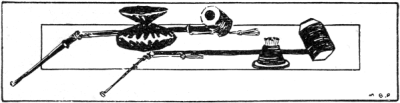
CHAPTER VI.MY SMOKING-TABLE.
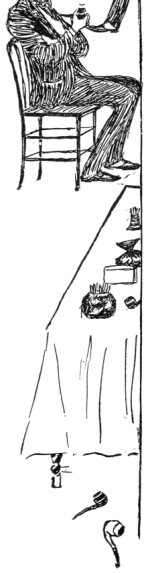
The fatal defect of the smoking-table, however,
[pg 48]
Though I still admired smoking-tables as much as ever, I began to want very much to give this one away. The difficulty was not so much to know whom to give it to as how to tie it up. My brother was the very person, for I owed him a letter, and this, I thought, would do instead. For a month I meant to pack the table up and send it to him; but I always put off doing it, and at last I thought the best plan would be to give it to Scrymgeour, who liked elegant furniture. As a smoker, Scrymgeour seemed the very man to appreciate a pretty, useful little table. Besides, all I had to do was to send William John down with it. Scrymgeour was out at the time; but we left it at the side of his fireplace as a pleasant surprise. Next morning, to my indignation, it was back at the side of my fireplace, and in the evening Scrymgeour came and upbraided me for trying, [pg 50] as he most unworthily expressed it, "to palm the thing off on him." He was no sooner gone than I took the table to pieces to send it to my brother. I tied the stalk up in brown paper, meaning to get a box for the other parts. William John sent off the stalk, and for some days the other pieces littered the floor. My brother wrote me saying he had received something from me, for which his best thanks; but would I tell him what it was, as it puzzled everybody? This was his impatient way; but I made an effort, and sent off the other pieces to him in a hat-box. That was a year ago, and since then I have only heard the history of the smoking-table in fragments. My brother liked it immensely; but he thought it was too luxurious for a married man, so he sent it to Reynolds, in Edinburgh. Not knowing Reynolds, I cannot say what his opinion was; but soon afterward I heard of its being in the possession of Grayson, who was charmed with it, but gave it to Pelle, because it was hardly in its place in a bachelor's establishment. Later a town man sent it to a country gentleman as just the thing for the country; and it was afterward in Liverpool as the very thing for a town. There I thought it was lost, so far as I was concerned. [pg 51] One day, however, Boyd, a friend of mine who lives in Glasgow, came to me for a week, and about six hours afterward he said that he had a present for me. He brought it into my sitting-room—a bulky parcel—and while he was undoing the cords he told me it was something quite novel; he had bought it in Glasgow the day before. When I saw a walnut leg I started; in another two minutes I was trying to thank Boyd for my own smoking-table. I recognized it by the dents. I was too much the gentleman to insist on an explanation from Boyd; but, though it seems a harsh thing to say, my opinion is that these different persons gave the table away because they wanted to get rid of it. William John has it now. 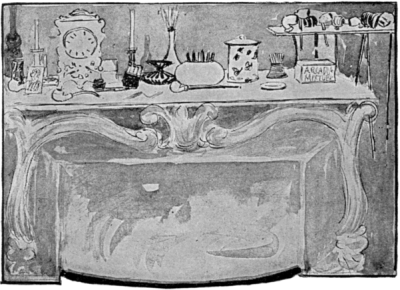
CHAPTER VII.GILRAY.
We met first in the Merediths' house-boat, the Tawny Owl, which was then lying at Molesey. Gilray, as I soon saw, was a man trying to be miserable, and finding it the hardest task in life. It is strange that the philosophers have never hit upon this profound truth. No man ever tried harder to be unhappy than Gilray; but the luck was [pg 53] against him, and he was always forgetting himself. Mark Tapley succeeded in being jolly in adverse circumstances; Gilray failed, on the whole, in being miserable in a delightful house-boat. It is, however, so much more difficult to keep up misery than jollity that I like to think of his attempt as what the dramatic critics call a succès d'estime. The Tawny Owl lay on the far side of the island. There were ladies in it; and Gilray's misery was meant to date from the moment when he asked one of them a question, and she said "No." Gilray was strangely unlucky during the whole of his time on board. His evil genius was there, though there was very little room for him, and played sad pranks. Up to the time of his asking the question referred to, Gilray meant to create a pleasant impression by being jolly, and he only succeeded in being as depressing as Jaques. Afterward he was to be unutterably miserable; and it was all he could do to keep himself at times from whirling about in waltz tune. But then the nearest boat had a piano on board, and some one was constantly playing dance music. Gilray had an idea that it would have been the proper thing to leave Molesey when she said "No;" and he would have done so had not the barbel-fishing been [pg 54] so good. The barbel-fishing was altogether unfortunate—at least Gilray's passion for it was. I have thought—and so sometimes has Gilray—that if it had not been for a barbel she might not have said "No." He was fishing from the house-boat when he asked the question. You know how you fish from a house-boat. The line is flung into the water and the rod laid down on deck. You keep an eye on it. Barbel-fishing, in fact, reminds one of the independent sort of man who is quite willing to play host to you, but wishes you clearly to understand at the same time that he can do without you. "Glad to see you with us if you have nothing better to do; but please yourself," is what he says to his friends. This is also the form of invitation to barbel. Now it happened that she and Gilray were left alone in the house-boat. It was evening; some Chinese lanterns had been lighted, and Gilray, though you would not think it to look at him, is romantic. He cast his line, and, turning to his companion, asked her the question. From what he has told me he asked it very properly, and all seemed to be going well. She turned away her head (which is said not to be a bad sign) and had begun to reply, when a woful thing happened. The line stiffened, and there was a whirl of the reel. Who can withstand [pg 55] that music? You can ask a question at any time, but, even at Molesey, barbel are only to be got now and then. Gilray rushed to his rod and began playing the fish. He called to his companion to get the landing-net. She did so; and after playing his barbel for ten minutes Gilray landed it. Then he turned to her again, and she said, "No." Gilray sees now that he made a mistake in not departing that night by the last train. He overestimated his strength. However, we had something to do with his staying on, and he persuaded himself that he remained just to show her that she had ruined his life. Once, I believe, he repeated his question; but in reply she only asked him if he had caught any more barbel. Considering the surprisingly fine weather, the barbel-fishing, and the piano on the other boat, Gilray was perhaps as miserable as could reasonably have been expected. Where he ought to have scored best, however, he was most unlucky. She had a hammock swung between two trees, close to the boat, and there she lay, holding a novel in her hand. From the hammock she had a fine view of the deck, and this was Gilray's chance. As soon as he saw her comfortably settled, he pulled a long face and climbed on deck. There he walked up and [pg 56] down, trying to look the image of despair. When she made some remark to him, his plan was to show that, though he answered cordially, his cheerfulness was the result of a terrible inward struggle. He did contrive to accomplish this if he was waiting for her observation; but she sometimes took him unawares, starting a subject in which he was interested. Then, forgetting his character, he would talk eagerly or jest with her across the strip of water, until with a start he remembered what he had become. He would seek to recover himself after that; but of course it was too late to create a really lasting impression. Even when she left him alone, watching him, I fear, over the top of her novel, he disappointed himself. For five minutes or so everything would go well; he looked as dejected as possible; but as he fell he was succeeding he became so self-satisfied that he began to strut. A pleased expression crossed his face, and instead of allowing his head to hang dismally, he put it well back. Sometimes, when we wanted to please him, we said he looked as glum as a mute at a funeral. Even that, however, defeated his object, for it flattered him so much that he smiled with gratification.
Gilray made one great sacrifice by giving up
[pg 57]
smoking, though not indeed
such a sacrifice as mine, for up to this time he did not know the
Arcadia Mixture. Perhaps the only time he really did look as miserable
as he wished was
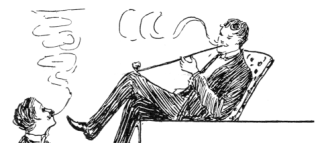
It was now that I approached him with the Arcadia Mixture. I seldom recommend the Arcadia to men whom I do not know intimately, lest in the after-years I should find them unworthy of it. But just as Aladdin doubtless rubbed his lamp at times for show, there were occasions when I was ostentatiously liberal. If, after trying the Arcadia, the lucky smoker to whom I presented it did not start or seize my hand, or otherwise show that something exquisite had come into his life, I at once forgot his name and his existence. I approached Gilray, then, and without a word handed him my pouch, while the others drew nearer. Nothing was to be heard but the water oozing out and in beneath the house-boat. Gilray pushed the tobacco from him, as he might have pushed a bag of diamonds that he mistook for pebbles. I placed it against his arm, and motioned to the others not to look. Then I sat down beside Gilray, and almost smoked into his eyes. Soon the aroma reached him, and rapture struggled into his face. Slowly his fingers fastened on the pouch. He filled his pipe without knowing [pg 59] what he was doing, and I handed him a lighted spill. He took perhaps three puffs, and then gave me a look of reverence that I know well. It only comes to a man once in all its glory—the first time he tries the Arcadia Mixture—but it never altogether leaves him. "Where do you get it?" Gilray whispered, in hoarse delight. The Arcadia had him for its own. 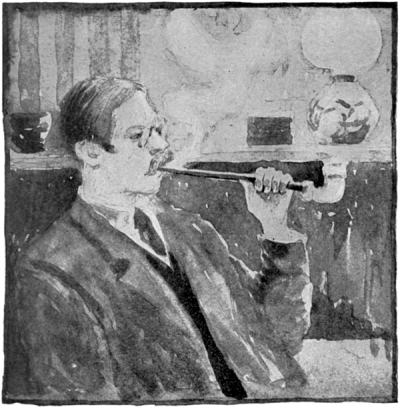
CHAPTER VIII.MARRIOT.
I have hinted that Marriot was our sentimental member. He was seldom sentimental until after midnight, and then only when he and I were alone. Why he should have chosen me as the pail into which to pour his troubles I cannot say. I let him talk on, and when he had ended I showed him plainly that I had been thinking most of the time about something else. Whether Marriot was entirely a humbug or the most conscientious person on our stair, readers may decide. He was fond of argument if you did not answer him, and often wanted me to tell him if I thought he was in love; if so, why did I think so; if not, why not. What makes me on reflection fancy that he was sincere is that in his statements he would let his pipe go out. Of course I cannot give his words, [pg 61] but he would wait till all my other guests had gone, then softly lock the door, and returning to the cane chair empty himself in some such way as this: "I have something I want to talk to you about. Pass me a spill. Well, it is this. Before I came to your rooms to-night I was cleaning my pipe, when all at once it struck me that I might be in love. This is the kind of shock that pulls a man up and together. My first thought was, if it be love, well and good; I shall go on. As a gentleman I know my duty both to her and to myself. At present, however, I am not certain which she is. In love there are no degrees; of that at least I feel positive. It is a tempestuous, surging passion, or it is nothing. The question for me, therefore, is, Is this the beginning of a tempestuous, surging passion? But stop; does such a passion have a beginning? Should it not be in flood before we know what we are about? I don't want you to answer.
"One of my difficulties is that I cannot reason from experience. I
cannot say to myself, During the spring of 1886, and again in October,
1888, your breast has known the insurgence of a tempestuous passion. Do
you now note the same symptoms? Have you experienced a
[pg 62]
sudden sinking
at the heart, followed by thrills of exultation? Now I cannot even say
that my appetite has fallen off, but I am smoking
"What is it? I reply that I am stumped at once, unless I am allowed to
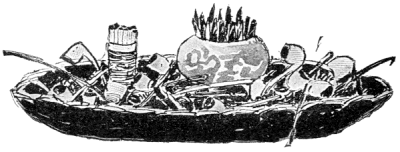
"Where is it? This is the simplest question of the four. It is in the heart. It fills the heart to overflowing, so that if there were one drop [pg 65] more the heart would run over. Love is thus plainly a liquid: which accounts to some extent for its well-recognized habit of surging. Among its effects this may be noted: that it makes you miserable if you be not by the loved one's side. To hold her hand is ecstasy, to press it, rapture. The fond lover—as it might be myself—sees his beloved depart on a railway journey with apprehension. He never ceases to remember that engines burst and trains run off the line. In an agony he awaits the telegram that tells him she has reached Shepherd's Bush in safety. When he sees her talking, as if she liked it, to another man, he is torn, he is rent asunder, he is dismembered by jealousy. He walks beneath her window till the policeman sees him home; and when he wakes in the morning, it is to murmur her name to himself until he falls asleep again and is late for the office. Well, do I experience such sensations, or do I not? Is this love, after all? Where are the spills? "I have been taking for granted that I know who it is. But is this wise? Nothing puzzles me so much as the way some men seem to know, by intuition, as it were, which is the woman for whom they have a passion. They take a girl from among their acquaintance, and never seem to understand that they may be taking [pg 66] the wrong one. However, with certain reservations, I do not think I go too far in saying that I know who she is. There is one other, indeed, that I have sometimes thought—but it fortunately happens that they are related, so that in any case I cannot go far wrong. After I have seen them again, or at least before I propose, I shall decide definitely on this point. "We have now advanced as far as Query IV. Now, what is to be done? Let us consider this calmly. In the first place, have I any option in the matter, or is love a hurricane that carries one hither and thither as a bottle is tossed in a chopping sea? I reply that it all depends on myself. Rosalind would say no; that we are without control over love. But Rosalind was a woman. It is probably true that a woman cannot conquer love. Man, being her ideal in the abstract, is irresistible to her in the concrete. But man, being an intellectual creature, can make a magnificent effort and cast love out. Should I think it advisable, I do not question my ability to open the gates of my heart and bid her go. That would be a serious thing for her; and, as man is powerful, so, I think, should he be merciful. She has, no doubt, gained admittance, as it were, furtively; but can I, as a gentleman, send away a weak, confiding woman who loves me [pg 67] simply because she cannot help it? Nay, more, in a pathetic case of this kind, have I not a certain responsibility? Does not her attachment to me give her a claim upon me? She saw me, and love came to her. She looks upon me as the noblest and best of my sex. I do not say I am; it may be that I am not. But I have the child's happiness in my hands; can I trample it beneath my feet? It seems to be my plain duty to take her to me.
"But there are others to consider. For me, would it not be the better
part to show her that the greatest happiness of the greatest number
should be my first consideration? Certainly there is nothing in a man I
despise more than conceit in affairs of this sort. When I hear one of my
sex boasting of his 'conquests,' I turn from him in disgust. 'Conquest'
implies effort; and to lay one's self out for victories over the other
sex always reminds me of pigeon-shooting. On the other hand, we must
make allowances for our position of advantage. These little ones
come into contact with us; they see us, athletic, beautiful, in the
hunting-field or at the wicket; they sit beside us at dinner and listen
to our brilliant conversation. They have met us, and the mischief is
done. Every man—except, perhaps, yourself and Jimmy—knows
[pg 68]
the names
of a few dear girls who have lost their hearts to him—some more, some
less. I do not pretend to be in a different position from my neighbors,
or in a better one. To some
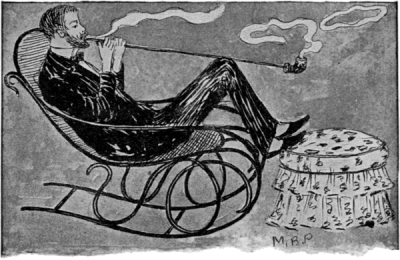
When he finished I would wake up, open the door for Marriot, and light him to his sleeping-chamber with a spill. 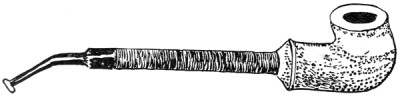
CHAPTER IX.JIMMY.
With the exception of myself, Jimmy Moggridge was no doubt the most
silent of the company that met so frequently in my rooms. Just as
Marriot's eyebrows rose if the cane chair was not empty when he strode
in, Jimmy held that he had a right to the hearth-rug, on which he loved
to lie prone, his back turned to the company and his eyes on his pipe.
The stem was a long cherry-wood, but the bowl was meerschaum, and Jimmy,
as he smoked, lay on the alert, as it were, to see the meerschaum
coloring.
[pg 71]
So one may strain his eyes with intent eagerness until he can
catch the hour-hand of a watch in action. With tobacco in his pocket
Jimmy could refill his pipe without moving,
Jimmy was a barrister—though this is scarcely worth mentioning—and it had been known to us for years that he made a living by [pg 72] contributing to the Saturday Review. How the secret leaked out I cannot say with certainty. Jimmy never forced it upon us, and I cannot remember any paragraphs in the London correspondence of the provincial papers coupling his name with Saturday articles. On the other hand, I distinctly recall having to wait one day in his chambers while Jimmy was shaving, and noticing accidentally a long, bulky envelope on his table, with the Saturday Review's mystic crest on it. It was addressed to Jimmy, and contained, I concluded, a bundle of proofs. That was so long ago as 1885. If further evidence is required, there is the undoubted fact, to which several of us could take oath, that, at Oxford, Jimmy was notorious for his sarcastic pen—nearly being sent down, indeed, for the same. Again, there was the certainty that for years Jimmy had been engaged upon literary work of some kind. We had been with him buying the largest-sized scribbling paper in the market; we had heard him muttering to himself as if in pain: and we had seen him correcting proof-sheets. When we caught him at them he always thrust the proofs into a drawer which he locked by putting his leg on it—for the ordinary lock was broken—and remaining in that position till we had retired. Though he rather [pg 73] shunned the subject as a rule, he admitted to us that the work was journalism and not a sarcastic history of the nineteenth century, on which we felt he would come out strong. Lastly, Jimmy had lost the brightness of his youth, and was become silent and moody, which is well known to be the result of writing satire.
Were it not so notorious that the thousands who write regularly for the
Saturday have reasons of their own for keeping it dark and merely
admitting the impeachment with a nod or smile, we might have marvelled
at Jimmy's reticence. There were, however, moments when he thawed so
far as practically to allow, and every one knows what that means, that
the Saturday was his chief source of income. "Only," he would
add, "should you be acquainted with the editor, don't mention my
contributions to him." From this we saw that Jimmy and the editor had an
understanding on the subject, though we were never agreed which of them
it was who had sworn the other to secrecy. We were proud of Jimmy's
connection with the press, and every week we discussed his latest
article. Jimmy never told us, except in a roundabout way, which were his
articles; but we knew his style, and it was quite exhilarating to pick
out his contributions week by week. We were never baffled,
[pg 74]
Now I come to the incident that drew from Jimmy his extraordinary statement. I was smoking with him in his rooms one evening, when a clatter at his door was followed by a thud on the floor. I knew as well as Jimmy what had happened. In his pre-Saturday days he had no letter-box, only a slit in the door; and through this we used to denounce him on certain occasions when we called and he would not let us in. Lately, however, he had fitted up a letter-box himself, which kept together if you opened the door gently, but came clattering to the floor under [pg 75] the weight of heavy letters. The letter to which it had succumbed this evening was quite a package, and could even have been used as a missile. Jimmy snatched it up quickly, evidently knowing the contents by their bulk; and I was just saying to myself, "More proofs from the Saturday," when the letter burst at the bottom, and in a moment a score of smaller letters were tumbling about my feet. In vain did Jimmy entreat me to let him gather them up. I helped, and saw, to my bewilderment, that all the letters were addressed in childish hands to "Uncle Jim, care of Editor of Mothers Pets." It was impossible that Jimmy could have so many nephews and nieces. Seeing that I had him, Jimmy advanced to the hearth-rug as if about to make his statement; then changed his mind and, thrusting a dozen of the letters into my hands, invited me to read. The first letter ran: "Dearest Uncle Jim,—I must tell you about my canary. I love my canary very much. It is a yellow canary, and it sings so sweetly. I keep it in a cage, and it is so tame. Mamma and me wishes you would come and see us and our canary. Dear Uncle Jim, I love you.—Your little friend, Milly (aged four years)." Here is the second: "Dear Uncle Jim,—You will want to know [pg 76] about my blackbird. It sits in a tree and picks up the crumbs on the window, and Thomas wants to shoot it for eating the cherries; but I won't let Thomas shoot it, for it is a nice blackbird, and I have wrote all this myself.—Your loving little Bobby (aged five years)." In another, Jacky (aged four and a half) described his parrot, and I have also vague recollections of Harry (aged six) on his chaffinch, and Archie (five) on his linnet. "What does it mean?" I demanded of Jimmy, who, while I read, had been smoking savagely. "Don't you see that they are in for the prize?" he growled. Then he made his statement. "I have never," Jimmy said, "contributed to the Saturday, nor, indeed, to any well-known paper. That, however, was only because the editors would not meet me half-way. After many disappointments, fortune—whether good or bad I cannot say—introduced me to the editor of Mothers Pets, a weekly journal whose title sufficiently suggests its character. Though you may never have heard of it, Mothers Pets has a wide circulation and is a great property. I was asked to join the staff under the name of 'Uncle Jim,' and did not see my way to refuse. I inaugurated a new feature. Mothers' pets were cordially invited to correspond with me on [pg 77] topics to be suggested week by week, and prizes were to be given for the best letters. This feature has been an enormous success, and I get the most affectionate letters from mothers, consulting me about teething and the like, every week. They say that I am dearer to their children than most real uncles, and they often urge me to go and stay with them. There are lots of kisses awaiting me. I also get similar invitations from the little beasts themselves. Pass the Arcadia." 
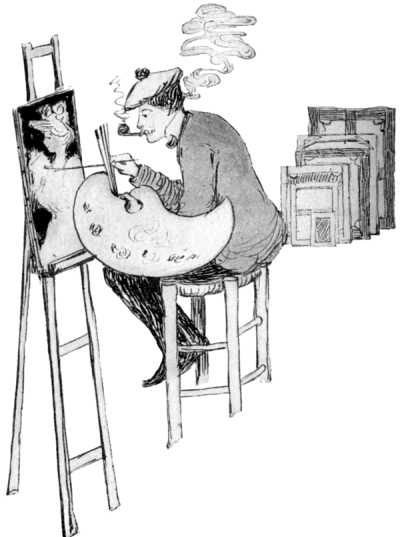
CHAPTER X.SCRYMGEOUR.Scrymgeour was an artist and a man of means, so proud of his profession that he gave all his pictures fancy prices, and so wealthy that he could have bought them. To him I went when I wanted money—though it must not be thought that I borrowed. In the days of the Arcadia Mixture I had no bank account. As [pg 79] my checks dribbled in I stuffed them into a torn leather case that was kept together by a piece of twine, and when Want tapped at my chamber door, I drew out the check that seemed most willing to come, and exchanged with Scrymgeour. In his detestation of argument Scrymgeour resembled myself, but otherwise we differed as much as men may differ who smoke the Arcadia. He read little, yet surprised us by a smattering of knowledge about all important books that had been out for a few months, until we discovered that he got his information from a friend in India. He had also, I remember, a romantic notion that Africa might be civilized by the Arcadia Mixture. As I shall explain presently, his devotion to the Arcadia very nearly married him against his will; but first I must describe his boudoir.
We always called it Scrymgeour's boudoir after it had ceased to deserve
the censure, just as we called Moggridge Jimmy because he was Jimmy to
some of us as a boy. Scrymgeour deserted his fine rooms in Bayswater for
the inn some months after the Arcadia Mixture had reconstructed him, but
his chambers were the best on our stair, and with the help of a workman
from the Japanese Village he converted them into an Oriental dream. Our
housekeeper
[pg 80]
thought little of the rest of us while the boudoir was
there to be gazed at, and even William John would not spill the coffee
in it. When the boudoir was ready for inspection, Scrymgeour led me to
it, and as the door opened I suddenly remembered that my boots were
muddy. The ceiling was a great Japanese Christmas card representing the
heavens; heavy clouds floated round a pale moon, and with the dusk the
stars came out. The walls, instead of being papered, were hung with a
soft Japanese cloth, and fantastic figures frolicked round a fireplace
that held a bamboo fan. There was no mantelpiece. The room was very
small; but when you wanted a blue velvet desk to write on, you had only
to press a spring against the wall; and if you leaned upon the desk the
Japanese workmen were ready to make you a new one. There were springs
everywhere, shaped like birds and mice and butterflies; and when you
touched one of them something was sure to come out. Blood-colored
curtains separated the room from the alcove where Scrymgeour was to rest
by night, and his bed became a bath by simply turning it upside down. On
one side of the bed was a wine-bin, with a ladder running up to it. The
door of the sitting-room was a symphony in gray, with shadowy reptiles
crawling across the
[pg 81]
panels; and the floor—dark, mysterious—presented
a fanciful picture of the infernal regions. Scrymgeour said hopefully
that the place would look cozier after he had his pictures in it; but he
stopped me when I began to fill my pipe.
It happened, however, that Scrymgeour had been several times in my rooms before I was able to visit him again. My hand was on his door-bell when I noticed a figure I thought I knew lounging at the foot of the stair. It was Scrymgeour [pg 82] himself, and he was smoking the Arcadia. We greeted each other languidly on the doorstep, Scrymgeour assuring me that "Japan in London" was a grand idea. It gave a zest to life, banishing the poor, weary conventionalities of one's surroundings. This was said while we still stood at the door, and I began to wonder why Scrymgeour did not enter his rooms. "A beautiful night," he said, rapturously. A cruel east wind was blowing. He insisted that evening was the time for thinking, and that east winds brace you up. Would I have a cigar? I would if he asked me inside to smoke it. My friend sighed. "I thought I told you," he said, "that I don't smoke in my chambers. It isn't the thing." Then he explained, hesitatingly, that he hadn't given up smoking. "I come down here," he said, "with my pipe, and walk up and down. I assure you it is quite a new sensation, and I much prefer it to lolling in an easy-chair." The poor fellow shivered as he spoke, and I noticed that his great-coat was tightly buttoned up to the throat. He had a hacking cough and his teeth were chattering. "Let us go in," I said; "I don't want to smoke." He knocked the ashes out of his pipe, and opened his door with an affectation of gayety. The room looked somewhat more home-like [pg 83] now, but it was very cold. Scrymgeour had no fire yet. He had been told that the smoke would blacken his moon. Besides, I question if he would have dared to remove the fan from the fireplace without consulting a Japanese authority. He did not even know whether the Japanese burned coal. I missed a number of the articles of furniture that had graced his former rooms. The easels were gone; there were none of the old canvases standing against the wall, and he had exchanged his comfortable, plain old screen for one with lizards crawling over it. "It would never have done," he explained, "to spoil the room with English things, so I got in some more Japanese furniture."
I asked him if he had sold his canvases; whereupon he signed me
to follow him to the wine-bin. It was full of them. There were no
newspapers lying about; but Scrymgeour hoped to manage to take one in
by and by. He was only feeling his way at present, he said. In the dim
light shed by a Japanese lamp, I tripped over a rainbow-colored slipper
that tapered to the heel and turned up at the toe. "I wonder you can get
into these things," I whispered, for the place depressed me; and he
answered, with similar caution, that he couldn't. "I keep them lying
about," he said, confidentially; "but after
[pg 84]
I think nobody is likely
to call I put on an old pair of English ones." At this point the
housekeeper knocked at the door, and Scrymgeour sprang like an acrobat
into a Japanese dressing-gown before he cried "Come in!" As I left I
Nearly a month elapsed before I looked in again. The unfortunate man had now a Japanese rug over his legs to keep out the cold, and he was gazing dejectedly at an outlandish mess which he called his lunch. He insisted that it was not at all bad; but it had evidently been on the table some time when I called, and he had not even tasted it. He ordered coffee for my benefit, but I do not care for coffee that has salt in it instead of sugar. I said that I had merely looked in to ask him to an early dinner at the club, and it was touching to see how he [pg 85] grasped at the idea. So complete, however, was his subjection to that terrible housekeeper, who believed in his fad, that he dared not send back her dishes untasted. As a compromise I suggested that he could wrap up some of the stuff in paper and drop it quietly into the gutter. We sallied forth, and I found him so weak that he had to be assisted into a hansom. He still maintained, however, that Japanese chambers were worth making some sacrifice for; and when the other Arcadians saw his condition they had the delicacy not to contradict him. They thought it was consumption. If we had not taken Scrymgeour in hand I dare not think what his craze might have reduced him to. A friend asked him into the country for ten days, and of course he was glad to go. As it happened, my chambers were being repapered at the time, and Scrymgeour gave me permission to occupy his rooms until his return. The other Arcadians agreed to meet me there nightly, and they were indefatigable in their efforts to put the boudoir to rights. Jimmy wrote letters to editors, of a most cutting nature, on the moon, breaking the table as he stepped on and off it, and we gave the butterflies to William John. The reptiles had to crawl off the door, and we made pipe-lights of the Japanese [pg 86] fans. Marriot shot the candles at the mice and birds; and Gilray, by improvising an entertainment behind the blood-red curtains, contrived to give them the dilapidated appearance without which there is no real comfort. In short, the boudoir soon assumed such a homely aspect that Scrymgeour on his return did not recognize it. When he realized where he was he lighted up at once. 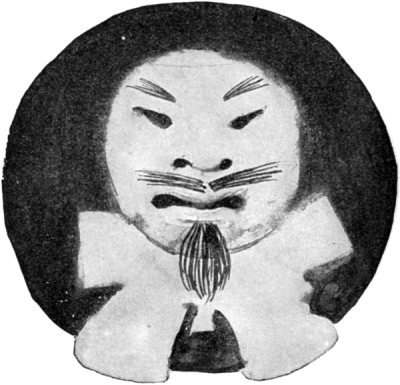
|
|||||||||||||||||||||||||||||||||||||||||||||||||||||||||||||||||||||||||||||||||||||||||||||||||||||||||||||||||
 £5 17s. yearly. That makes £33 4s. 6d. When we calculate
the yearly expense of tobacco in this way, we are naturally taken aback,
and our extravagance shocks us more after we have considered how much
more satisfactorily the money might have been spent. With £33 4s.
6d. you can buy new Oriental rugs for the drawing-room, as well as
a spring bonnet and a nice dress. These are things that give permanent
pleasure, whereas you have no interest in a cigar after flinging away
the stump. Judging by myself, I should say that it was want of thought
rather than selfishness that makes heavy smokers of so many bachelors.
Once a man marries, his eyes are opened to many things that he was quite
unaware of previously, among them being the delight of adding an article
of furniture to the drawing-room every month, and having a bedroom in
pink and gold, the door of which is always kept locked. If men would
only consider that every cigar they smoke would buy part of a new
piano-stool in terra-cotta plush,
£5 17s. yearly. That makes £33 4s. 6d. When we calculate
the yearly expense of tobacco in this way, we are naturally taken aback,
and our extravagance shocks us more after we have considered how much
more satisfactorily the money might have been spent. With £33 4s.
6d. you can buy new Oriental rugs for the drawing-room, as well as
a spring bonnet and a nice dress. These are things that give permanent
pleasure, whereas you have no interest in a cigar after flinging away
the stump. Judging by myself, I should say that it was want of thought
rather than selfishness that makes heavy smokers of so many bachelors.
Once a man marries, his eyes are opened to many things that he was quite
unaware of previously, among them being the delight of adding an article
of furniture to the drawing-room every month, and having a bedroom in
pink and gold, the door of which is always kept locked. If men would
only consider that every cigar they smoke would buy part of a new
piano-stool in terra-cotta plush,
 rose from
his chair, apparently to leave the room, and then sat down again, as if
he had thought better of it. He did this several times, always eying me
narrowly. Wondering how I could make it easier for him, I took up a book
and pretended to read with deep attention, meaning to show him that he
could go away if he liked without my noticing it. At last he jumped up,
and, looking at me boldly, as if to show that the house was his and
he could do what he liked in it, went heavily from the room. As soon
as he was gone I laid down my book. I was now in a state of nervous
excitement, though outwardly I was quite calm. I took a look at him as
he went up the stairs, and noticed that he had slipped off his shoes
on the bottom step. All haughtiness had left him now.
rose from
his chair, apparently to leave the room, and then sat down again, as if
he had thought better of it. He did this several times, always eying me
narrowly. Wondering how I could make it easier for him, I took up a book
and pretended to read with deep attention, meaning to show him that he
could go away if he liked without my noticing it. At last he jumped up,
and, looking at me boldly, as if to show that the house was his and
he could do what he liked in it, went heavily from the room. As soon
as he was gone I laid down my book. I was now in a state of nervous
excitement, though outwardly I was quite calm. I took a look at him as
he went up the stairs, and noticed that he had slipped off his shoes
on the bottom step. All haughtiness had left him now.
 Even though I became attached to you, I might not like to take the
responsibility of introducing you to the Arcadia. This mixture has an
extraordinary effect upon character, and probably you want to remain as
you are. Before I discovered the Arcadia, and communicated it to the
other five—including Pettigrew—we had all distinct individualities,
but now, except in appearance—and the Arcadia even tells on that—we
are as like as holly leaves. We have the same habits, the same ways of
looking at things, the same satisfaction in each other. No doubt we are
not yet absolutely alike, indeed I intend to prove this, but in given
circumstances we would probably do the same thing, and, furthermore, it
would be what other people would not do. Thus when we are together we
are only to be distinguished by
Even though I became attached to you, I might not like to take the
responsibility of introducing you to the Arcadia. This mixture has an
extraordinary effect upon character, and probably you want to remain as
you are. Before I discovered the Arcadia, and communicated it to the
other five—including Pettigrew—we had all distinct individualities,
but now, except in appearance—and the Arcadia even tells on that—we
are as like as holly leaves. We have the same habits, the same ways of
looking at things, the same satisfaction in each other. No doubt we are
not yet absolutely alike, indeed I intend to prove this, but in given
circumstances we would probably do the same thing, and, furthermore, it
would be what other people would not do. Thus when we are together we
are only to be distinguished by
 of us.
Among the first effects of the Arcadia is to put an end to jabber.
Gilray had at one time the reputation of being such a brilliant talker
that Arcadians locked their doors on him, but now he is a man that can
be invited anywhere. The Arcadia is entirely responsible for the change.
Perhaps I myself am the most silent of our company, and hostesses
usually think me shy. They ask ladies to draw me out, and when the
ladies find me as hopeless as a sulky drawer, they call me stupid. The
charge may be true, but I do not resent it, for I smoke the Arcadia
Mixture, and am consequently indifferent to abuse.
of us.
Among the first effects of the Arcadia is to put an end to jabber.
Gilray had at one time the reputation of being such a brilliant talker
that Arcadians locked their doors on him, but now he is a man that can
be invited anywhere. The Arcadia is entirely responsible for the change.
Perhaps I myself am the most silent of our company, and hostesses
usually think me shy. They ask ladies to draw me out, and when the
ladies find me as hopeless as a sulky drawer, they call me stupid. The
charge may be true, but I do not resent it, for I smoke the Arcadia
Mixture, and am consequently indifferent to abuse.
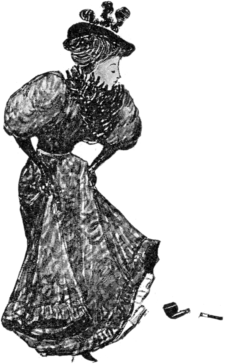 This brings me to one of the many advantages that my brier had over
all other pipes. It has given me a reputation for gallantry, to which
without it I fear I could lay no claim. I used to have a passion for
repartee, especially in the society of ladies. But it is with me as with
many other men of parts whose wit has ever to be fired by a long fuse:
my best things strike me as I wend my way home. This embittered my early
days; and not till the pride of youth had been tamed could I stop to lay
in a stock of repartee on likely subjects the night before.
This brings me to one of the many advantages that my brier had over
all other pipes. It has given me a reputation for gallantry, to which
without it I fear I could lay no claim. I used to have a passion for
repartee, especially in the society of ladies. But it is with me as with
many other men of parts whose wit has ever to be fired by a long fuse:
my best things strike me as I wend my way home. This embittered my early
days; and not till the pride of youth had been tamed could I stop to lay
in a stock of repartee on likely subjects the night before.
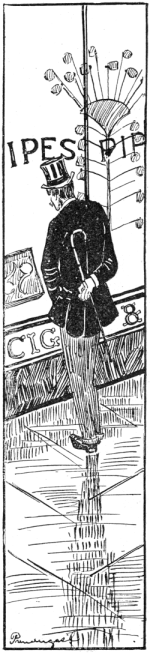 cling to each other
in fear of death. With such a fire it is no use attempting to light a
pipe all at once. Your better course now is to drop little bits of paper
into the likely places in the fire, and have a spill ready to apply to
the one that lights first. It is an anxious moment, for they may merely
shrivel up sullenly without catching fire, and in that case some men
lose their tempers. Bad to lose your temper over your pipe——
cling to each other
in fear of death. With such a fire it is no use attempting to light a
pipe all at once. Your better course now is to drop little bits of paper
into the likely places in the fire, and have a spill ready to apply to
the one that lights first. It is an anxious moment, for they may merely
shrivel up sullenly without catching fire, and in that case some men
lose their tempers. Bad to lose your temper over your pipe——
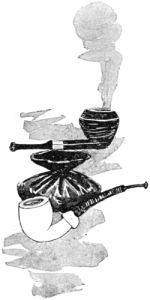 Even then I do
not know that I should have bought the pipes until the six months were
up, had I not been driven to it by jealousy. On my life, love for a pipe
is ever like love for a woman, though they say it is not so acute. Many
a man thinks there is no haste to propose until he sees a hated rival
approaching. Even if he is not in a hurry for the lady himself, he
loathes the idea of her giving herself, in a moment of madness, to
that other fellow. Rather than allow that, he proposes himself, and so
insures her happiness. It was so with me. Romulus and Remus were taken
from the window to show to a black-bearded, swarthy man, whom I
suspected of designs upon them the moment he entered the shop. Ah, the
agony of waiting until he came out! He was not worthy of them. I never
knew how much I loved them until I had nearly lost them. As soon as he
was gone I asked if
Even then I do
not know that I should have bought the pipes until the six months were
up, had I not been driven to it by jealousy. On my life, love for a pipe
is ever like love for a woman, though they say it is not so acute. Many
a man thinks there is no haste to propose until he sees a hated rival
approaching. Even if he is not in a hurry for the lady himself, he
loathes the idea of her giving herself, in a moment of madness, to
that other fellow. Rather than allow that, he proposes himself, and so
insures her happiness. It was so with me. Romulus and Remus were taken
from the window to show to a black-bearded, swarthy man, whom I
suspected of designs upon them the moment he entered the shop. Ah, the
agony of waiting until he came out! He was not worthy of them. I never
knew how much I loved them until I had nearly lost them. As soon as he
was gone I asked if
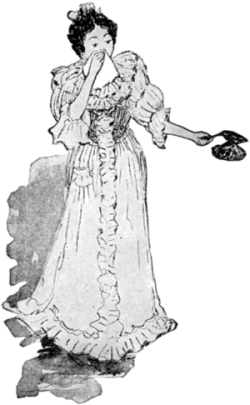 never saw it, even in my own
room, without putting a book or pamphlet over it. They called it "that
thing," and made tongs of their knitting-needles to lift it; and when I
indignantly returned it to my pocket, they raised their hands to signify
that I would not listen to reason. It seemed to come natural to other
persons to present me with new tobacco-pouches, until I had nearly a
score lying neglected in drawers. But I am not the man to desert an old
friend that has been with me everywhere and thoroughly knows my ways.
Once, indeed,
never saw it, even in my own
room, without putting a book or pamphlet over it. They called it "that
thing," and made tongs of their knitting-needles to lift it; and when I
indignantly returned it to my pocket, they raised their hands to signify
that I would not listen to reason. It seemed to come natural to other
persons to present me with new tobacco-pouches, until I had nearly a
score lying neglected in drawers. But I am not the man to desert an old
friend that has been with me everywhere and thoroughly knows my ways.
Once, indeed,
 On the following afternoon I was again at Stratford. So far as I could
remember, I had flung away the pouch within a few miles of the station;
but I did not look for it until dusk. I felt that the porters had their
eyes on me. By crouching along hedges I at last reached the railway a
mile or two from the station, and began my search. It may be thought
that the chances were against my finding the pouch; but I recovered it
without much difficulty. The scene as I flung my old friend out at the
window had burned itself into my brain, and I could go to the spot
to-day as readily as I went on that occasion. There it was, lying among
the grass, but not quite in the place where it had fallen. Apparently
some navvy had found
On the following afternoon I was again at Stratford. So far as I could
remember, I had flung away the pouch within a few miles of the station;
but I did not look for it until dusk. I felt that the porters had their
eyes on me. By crouching along hedges I at last reached the railway a
mile or two from the station, and began my search. It may be thought
that the chances were against my finding the pouch; but I recovered it
without much difficulty. The scene as I flung my old friend out at the
window had burned itself into my brain, and I could go to the spot
to-day as readily as I went on that occasion. There it was, lying among
the grass, but not quite in the place where it had fallen. Apparently
some navvy had found
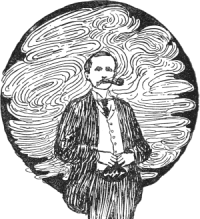
 I have not described the appearance of my pouch, feeling that to be
unnecessary. It never, I fear, quite recovered from its night in the
rain, and as my female relatives refused to touch it, I had to sew it
together now and then myself. Gilray used to boast of a way of mending
a hole in a tobacco-pouch that was better than sewing. You put the two
pieces of gutta-percha close together and then cut them sharply with
scissors. This makes them run together, he says, and I believed him
until he experimented upon my pouch. However, I did not object to a hole
here and there. Wherever I laid that pouch it left a small deposit of
tobacco, and thus I could
I have not described the appearance of my pouch, feeling that to be
unnecessary. It never, I fear, quite recovered from its night in the
rain, and as my female relatives refused to touch it, I had to sew it
together now and then myself. Gilray used to boast of a way of mending
a hole in a tobacco-pouch that was better than sewing. You put the two
pieces of gutta-percha close together and then cut them sharply with
scissors. This makes them run together, he says, and I believed him
until he experimented upon my pouch. However, I did not object to a hole
here and there. Wherever I laid that pouch it left a small deposit of
tobacco, and thus I could
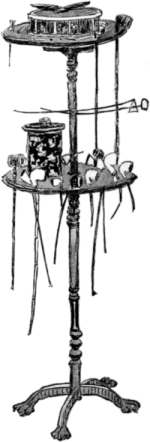 Had it not been for a bootblack at Charing Cross I should probably never
have bought the smoking-table. I had to pass that boy every morning. In
vain did I scowl at him, or pass with my head to the side. He always
pointed derisively (as I thought) at my boots. Probably my boots were
speckless, but that made no difference; he jeered and sneered. I have
never hated any one as I loathed that boy, and to escape him I took to
going round by the Lowther Arcade. It was here that my eye fell on the
smoking-table. In the Lowther Arcade, if the attendants catch you
looking
Had it not been for a bootblack at Charing Cross I should probably never
have bought the smoking-table. I had to pass that boy every morning. In
vain did I scowl at him, or pass with my head to the side. He always
pointed derisively (as I thought) at my boots. Probably my boots were
speckless, but that made no difference; he jeered and sneered. I have
never hated any one as I loathed that boy, and to escape him I took to
going round by the Lowther Arcade. It was here that my eye fell on the
smoking-table. In the Lowther Arcade, if the attendants catch you
looking
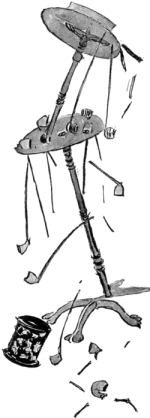 was that it was generally
rolling about the floor—the stalk in one corner, the slabs here and
there, the cigars on the rug to be trampled on, the lid of the
tobacco-jar beneath a chair. Every morning William John had to put the
table together. Sometimes I had knocked it over accidentally. I would
fling a crumpled piece of paper into the waste-paper basket. It missed
the basket but hit the smoking-table, which went down like a wooden
soldier. When my fire went out, just because I had taken my eyes off it
for a moment, I called it names and flung the tongs at it. There was a
crash—the smoking-table again.
was that it was generally
rolling about the floor—the stalk in one corner, the slabs here and
there, the cigars on the rug to be trampled on, the lid of the
tobacco-jar beneath a chair. Every morning William John had to put the
table together. Sometimes I had knocked it over accidentally. I would
fling a crumpled piece of paper into the waste-paper basket. It missed
the basket but hit the smoking-table, which went down like a wooden
soldier. When my fire went out, just because I had taken my eyes off it
for a moment, I called it names and flung the tongs at it. There was a
crash—the smoking-table again.
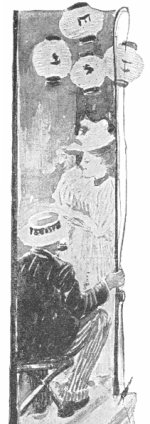
 Gilray is an actor, whose life I may be said to have strangely
influenced, for it was I who brought him and the Arcadia Mixture
together. After that his coming to live on our stair was only a matter
of rooms being vacant.
Gilray is an actor, whose life I may be said to have strangely
influenced, for it was I who brought him and the Arcadia Mixture
together. After that his coming to live on our stair was only a matter
of rooms being vacant.
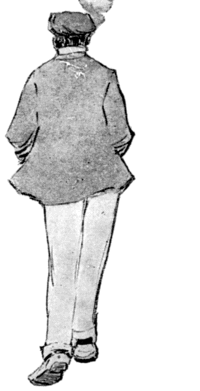 late at night when we men sat up for a second last pipe
before turning in. He looked wistfully at us from a corner. Yet as She
had gone to rest, cruel fate made this of little account. His gloomy
face saddened us too, and we tried to entice him to shame by promising
not to mention it to the ladies. He almost yielded, and showed us that
while we smoked he had been holding his empty brier in his right hand.
For a moment he hesitated, then said fiercely that he did not care for
smoking. Next night he was shown a novel, the hero of which had been
"refused." Though the lady's hard-heartedness had a terrible effect on
this fine fellow, he "strode away blowing great clouds into the air."
"Standing there smoking in the moonlight," the authoress says in her
next chapter, "De Courcy was a strangely romantic figure. He looked like
a man who had done everything, who had been through the
late at night when we men sat up for a second last pipe
before turning in. He looked wistfully at us from a corner. Yet as She
had gone to rest, cruel fate made this of little account. His gloomy
face saddened us too, and we tried to entice him to shame by promising
not to mention it to the ladies. He almost yielded, and showed us that
while we smoked he had been holding his empty brier in his right hand.
For a moment he hesitated, then said fiercely that he did not care for
smoking. Next night he was shown a novel, the hero of which had been
"refused." Though the lady's hard-heartedness had a terrible effect on
this fine fellow, he "strode away blowing great clouds into the air."
"Standing there smoking in the moonlight," the authoress says in her
next chapter, "De Courcy was a strangely romantic figure. He looked like
a man who had done everything, who had been through the
 more than ever, and it
is notorious that I experience sudden chills and thrills. Is this
passion? No, I am not done; I have only begun.
more than ever, and it
is notorious that I experience sudden chills and thrills. Is this
passion? No, I am not done; I have only begun.
 "In 'As You Like It,' you remember, the love symptoms are described at
length. But is Rosalind to be taken seriously? Besides, though
she wore boy's clothes, she had only the woman's point of view. I have
consulted Stevenson's chapters on love in his delightful 'Virginibus
Puerisque,' and one of them says, 'Certainly, if I could help it, I
would never marry a wife who wrote.' Then I noticed a book published
after that one, and entitled 'The New Arabian Nights, by Mr. and Mrs.
Robert Louis Stevenson.' I shut 'Virginibus Puerisque' with a sigh, and
put it away.
"In 'As You Like It,' you remember, the love symptoms are described at
length. But is Rosalind to be taken seriously? Besides, though
she wore boy's clothes, she had only the woman's point of view. I have
consulted Stevenson's chapters on love in his delightful 'Virginibus
Puerisque,' and one of them says, 'Certainly, if I could help it, I
would never marry a wife who wrote.' Then I noticed a book published
after that one, and entitled 'The New Arabian Nights, by Mr. and Mrs.
Robert Louis Stevenson.' I shut 'Virginibus Puerisque' with a sigh, and
put it away.
 "But this inquiry need not, I feel confident, lead to nothing.
Negatively I know love; for I do not require to be told what it is not,
and I have my ideal. Putting my knowledge
"But this inquiry need not, I feel confident, lead to nothing.
Negatively I know love; for I do not require to be told what it is not,
and I have my ideal. Putting my knowledge
 "I may lay down as Proposition I. that surging, tempestuous passion
comes involuntarily. You are heart-whole, when, as it were, the gates
of your bosom open, in she sweeps, and the gates close. So far this is
a faithful description of my case. Whatever it is, it came without any
desire or volition on my part, and it looks as if it meant to stay. What
I ask myself is—first, What is it? secondly, Where is it? thirdly, Who
is it? and fourthly, What shall I do with it? I have thus my work cut
out for me.
"I may lay down as Proposition I. that surging, tempestuous passion
comes involuntarily. You are heart-whole, when, as it were, the gates
of your bosom open, in she sweeps, and the gates close. So far this is
a faithful description of my case. Whatever it is, it came without any
desire or volition on my part, and it looks as if it meant to stay. What
I ask myself is—first, What is it? secondly, Where is it? thirdly, Who
is it? and fourthly, What shall I do with it? I have thus my work cut
out for me.
 fix upon an object definitely and precisely. This, no doubt, is arguing
in a circle; but Descartes himself assumed what he was to try to prove.
This, then, being permitted, I have chosen my object, and we can now go
on again. What is it? Some might
fix upon an object definitely and precisely. This, no doubt, is arguing
in a circle; but Descartes himself assumed what he was to try to prove.
This, then, being permitted, I have chosen my object, and we can now go
on again. What is it? Some might
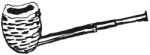 evade the difficulty by taking a middle
course. You are not, they might say, in love
evade the difficulty by taking a middle
course. You are not, they might say, in love
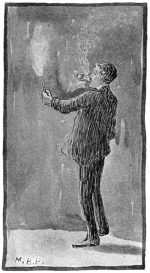 slight extent I may be to blame. But, after
all, when a man sees cheeks redden and eyes brighten at his approach,
he loses prudence. At the time he does not think what may be the
consequences. But the day comes when he sees that he must take heed what
he is about. He communes with himself about the future, and if he be a
man of honor he maps out in his mind the several courses it is allowed
him to follow, and chooses that one which he may tread with least pain
to others. May that day for introspection come to few as it has
slight extent I may be to blame. But, after
all, when a man sees cheeks redden and eyes brighten at his approach,
he loses prudence. At the time he does not think what may be the
consequences. But the day comes when he sees that he must take heed what
he is about. He communes with himself about the future, and if he be a
man of honor he maps out in his mind the several courses it is allowed
him to follow, and chooses that one which he may tread with least pain
to others. May that day for introspection come to few as it has
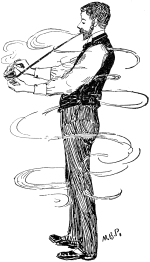 but sometimes he crawled
along the hearth-rug to let the fire-light play more exquisitely on his
meerschaum bowl. In time, of course, the Arcadia Mixture made him more
and more like the rest of us, but he retained his individuality until he
let his bowl fall off. Otherwise he only differed from us in one way.
When he saw a match-box he always extracted a few matches and put them
dreamily into his pocket. There were times when, with a sharp blow on
Jimmy's person, we could doubtless have had him blazing like a
chandelier.
but sometimes he crawled
along the hearth-rug to let the fire-light play more exquisitely on his
meerschaum bowl. In time, of course, the Arcadia Mixture made him more
and more like the rest of us, but he retained his individuality until he
let his bowl fall off. Otherwise he only differed from us in one way.
When he saw a match-box he always extracted a few matches and put them
dreamily into his pocket. There were times when, with a sharp blow on
Jimmy's person, we could doubtless have had him blazing like a
chandelier.
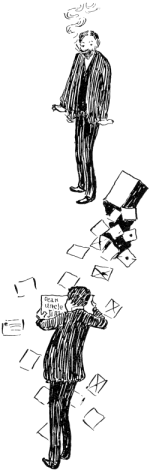 for "Jimmy's
touches" were unmistakable; and "Have you seen Jimmy this week in the
Saturday on Lewis Morris?" or, "I say, do you think Buchanan
knows it was Jimmy who wrote that?" was what we said when we had lighted
our pipes.
for "Jimmy's
touches" were unmistakable; and "Have you seen Jimmy this week in the
Saturday on Lewis Morris?" or, "I say, do you think Buchanan
knows it was Jimmy who wrote that?" was what we said when we had lighted
our pipes.
 He believed, he said, that
smoking was not a Japanese custom; and there was no use taking Japanese
chambers unless you lived up to them. Here was a revelation. Scrymgeour
proposed to live his life in harmony with these rooms. I felt too sad at
heart to say much to him then, but, promising to look in again soon, I
shook hands with my unhappy friend and went away.
He believed, he said, that
smoking was not a Japanese custom; and there was no use taking Japanese
chambers unless you lived up to them. Here was a revelation. Scrymgeour
proposed to live his life in harmony with these rooms. I felt too sad at
heart to say much to him then, but, promising to look in again soon, I
shook hands with my unhappy friend and went away.
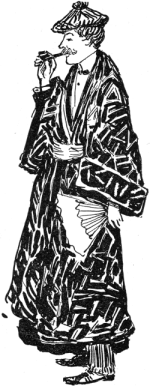 asked him how he felt now, and he said that he had never been so happy
in his life. But his hand was hot, and he did not look me in the face.
asked him how he felt now, and he said that he had never been so happy
in his life. But his hand was hot, and he did not look me in the face.
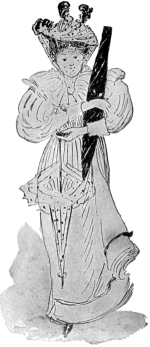 CHAPTER XI.
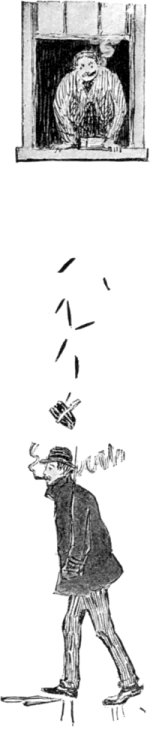 so crammed that he dreams the lock has given way. The key is always in
his pocket, yet when his children approach the cupboard he orders them
away, so fearful is he of something happening. When his wife has retired
he sometimes unlocks the cupboard with nervous hand, when the door
bursts gladly open, and the things roll on to the carpet. They are the
cigars his wife gives him as birthday presents, on the anniversary of
his marriage, and at other times, and such a model wife is she that he
would do anything for her except smoke them. They are Celebros, Regalia
Rothschilds, twelve and six the hundred. I discovered Pettigrew's secret
one night, when, as I was passing his house, a packet of Celebros
alighted on my head. I demanded an explanation, and I got it on the
promise that I would not mention the matter to the other Arcadians.
so crammed that he dreams the lock has given way. The key is always in
his pocket, yet when his children approach the cupboard he orders them
away, so fearful is he of something happening. When his wife has retired
he sometimes unlocks the cupboard with nervous hand, when the door
bursts gladly open, and the things roll on to the carpet. They are the
cigars his wife gives him as birthday presents, on the anniversary of
his marriage, and at other times, and such a model wife is she that he
would do anything for her except smoke them. They are Celebros, Regalia
Rothschilds, twelve and six the hundred. I discovered Pettigrew's secret
one night, when, as I was passing his house, a packet of Celebros
alighted on my head. I demanded an explanation, and I got it on the
promise that I would not mention the matter to the other Arcadians.
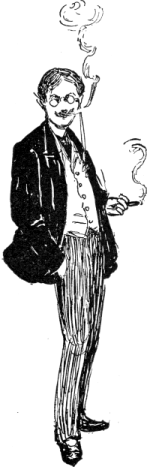 with the tobacconist, and I told her the cigars
were excellent. Yes, they were as choice a brand as I had ever smoked.
She clapped her hands joyously at that, and said that if she had not
made up her mind never to do so she would tell me what they cost. Next
she asked me to guess the price; I answered eighty shillings a hundred;
and then she confessed that she got the seven for a shilling. On our way
home she made arch remarks about men who judged cigars simply by their
price. I laughed gayly in reply, begging her not to be too hard on me;
and I did not even feel uneasy when she remarked that of course I would
never buy those horridly expensive Villar y Villars again. When I left
her I gave the Celebros to an acquaintance against whom I had long had a
grudge—we have not spoken since—but I
with the tobacconist, and I told her the cigars
were excellent. Yes, they were as choice a brand as I had ever smoked.
She clapped her hands joyously at that, and said that if she had not
made up her mind never to do so she would tell me what they cost. Next
she asked me to guess the price; I answered eighty shillings a hundred;
and then she confessed that she got the seven for a shilling. On our way
home she made arch remarks about men who judged cigars simply by their
price. I laughed gayly in reply, begging her not to be too hard on me;
and I did not even feel uneasy when she remarked that of course I would
never buy those horridly expensive Villar y Villars again. When I left
her I gave the Celebros to an acquaintance against whom I had long had a
grudge—we have not spoken since—but I
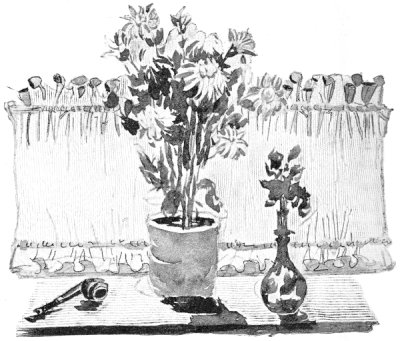
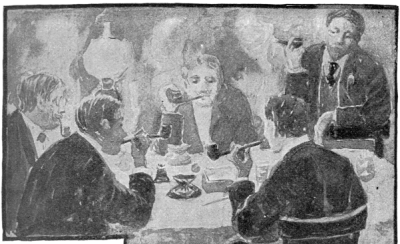

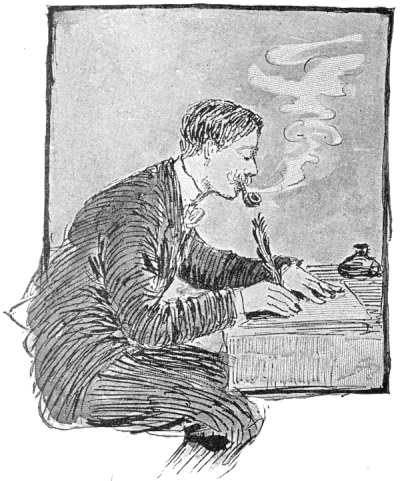
 Raleigh, in honor of whom England should have changed its name,
introduced tobacco into this country, the glorious Elizabethan age
began. I am aware that those hateful persons called Original Researchers
now maintain that Raleigh was not the man; but to them I turn a deaf
ear. I know, I feel, that with the introduction of tobacco England woke
up from a long sleep.
Raleigh, in honor of whom England should have changed its name,
introduced tobacco into this country, the glorious Elizabethan age
began. I am aware that those hateful persons called Original Researchers
now maintain that Raleigh was not the man; but to them I turn a deaf
ear. I know, I feel, that with the introduction of tobacco England woke
up from a long sleep.
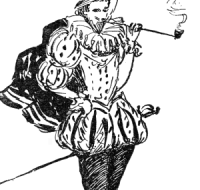
 Suddenly a new zest had been given to life. The
glory of existence became a thing to speak of. Men who had hitherto only
concerned themselves with the narrow things of home put a pipe into
their mouths and became philosophers. Poets and dramatists smoked until
all ignoble ideas were driven from them, and into their place rushed
such high thoughts as the world had not known before. Petty jealousies
no longer had hold of statesmen, who smoked, and agreed to work together
for the public weal. Soldiers and sailors felt, when engaged with a
foreign foe,
Suddenly a new zest had been given to life. The
glory of existence became a thing to speak of. Men who had hitherto only
concerned themselves with the narrow things of home put a pipe into
their mouths and became philosophers. Poets and dramatists smoked until
all ignoble ideas were driven from them, and into their place rushed
such high thoughts as the world had not known before. Petty jealousies
no longer had hold of statesmen, who smoked, and agreed to work together
for the public weal. Soldiers and sailors felt, when engaged with a
foreign foe,
 The short stout gentleman who is fond of making jokes, and not
particular whom he confides them to, has heard another good story about
Tarleton. This is the low comedian Kempe, who stepped into the shoes of
flat-nosed, squinting Tarleton the other day, but never quite manages to
fill them. He whispers the
The short stout gentleman who is fond of making jokes, and not
particular whom he confides them to, has heard another good story about
Tarleton. This is the low comedian Kempe, who stepped into the shoes of
flat-nosed, squinting Tarleton the other day, but never quite manages to
fill them. He whispers the
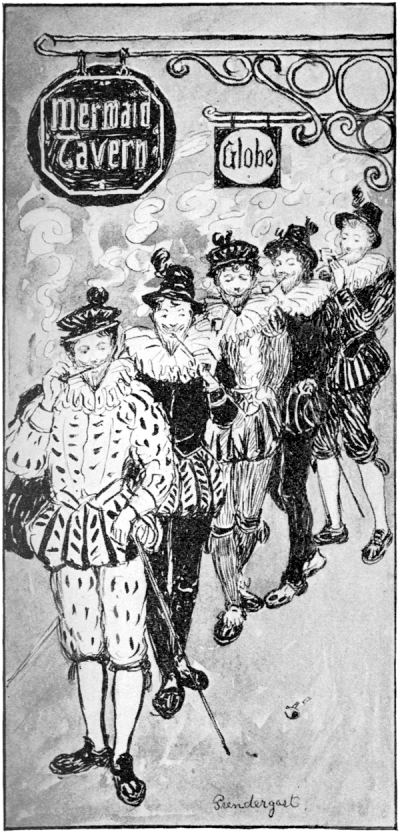


 surprise when
he heard that I was Henry, and his comments on my youthful appearance.
Besides, I was smoking the best of all mixtures. There was no likelihood
of my meeting Scudamour again, so the easiest way to get rid of him
seemed to be to humor him. I therefore told him that Henry was in India,
married, and doing well. "Remember me to Henry when you write to
surprise when
he heard that I was Henry, and his comments on my youthful appearance.
Besides, I was smoking the best of all mixtures. There was no likelihood
of my meeting Scudamour again, so the easiest way to get rid of him
seemed to be to humor him. I therefore told him that Henry was in India,
married, and doing well. "Remember me to Henry when you write to
 about your brother Henry, and he said that
there was no such person. Of course I laughed at that, and pointed out
not only that I had the pleasure of Henry's acquaintance, but that
you and I had talked about the old fellow every time we met. 'Well,'
Pettigrew said, 'this is a most remarkable thing; for he,' meaning
you, 'said to me in this very room, sitting in that very chair, that
Alexander was his only brother.' I saw that Pettigrew resented your
concealing the existence of your brother Henry from him, so I thought
the most friendly thing I could do was to tell him that your reticence
was doubtless due to the unhappy state of poor Henry's private affairs.
Naturally in the circumstances you did not want to talk about Henry." I
shook Scudamour by the hand, telling him that he had acted judiciously;
but if I could have stabbed
about your brother Henry, and he said that
there was no such person. Of course I laughed at that, and pointed out
not only that I had the pleasure of Henry's acquaintance, but that
you and I had talked about the old fellow every time we met. 'Well,'
Pettigrew said, 'this is a most remarkable thing; for he,' meaning
you, 'said to me in this very room, sitting in that very chair, that
Alexander was his only brother.' I saw that Pettigrew resented your
concealing the existence of your brother Henry from him, so I thought
the most friendly thing I could do was to tell him that your reticence
was doubtless due to the unhappy state of poor Henry's private affairs.
Naturally in the circumstances you did not want to talk about Henry." I
shook Scudamour by the hand, telling him that he had acted judiciously;
but if I could have stabbed
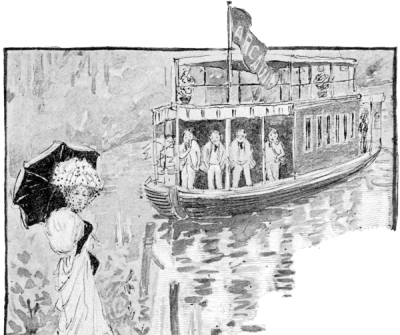
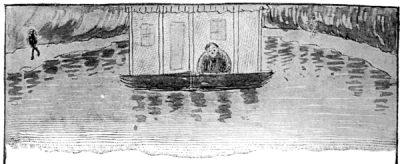


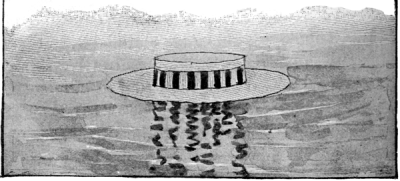
 was his way of breaking them; and
he was by nature so patient and humble that he rather flattered himself
when a coal broke at the twentieth attempt. We used to dream that he was
breaking coals on our heads. Often one of us dashed into the kitchen,
threatening to drop him into the river if he did not sit quite still
on a chair for the next two hours. Under these threats he looked
sufficiently scared to satisfy anybody; but as soon as all was quiet
again he crept back to the coal-bunk and was at his old games.
was his way of breaking them; and
he was by nature so patient and humble that he rather flattered himself
when a coal broke at the twentieth attempt. We used to dream that he was
breaking coals on our heads. Often one of us dashed into the kitchen,
threatening to drop him into the river if he did not sit quite still
on a chair for the next two hours. Under these threats he looked
sufficiently scared to satisfy anybody; but as soon as all was quiet
again he crept back to the coal-bunk and was at his old games.
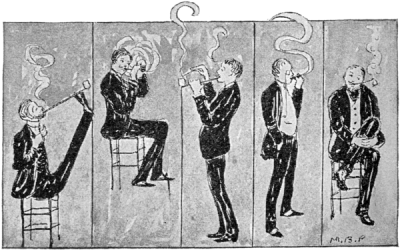
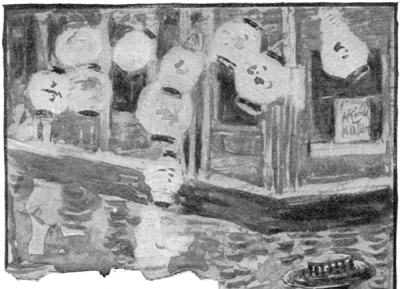
 the house-boat, came from the kitchen, where a servant
was breaking crockery for supper. The romantic figure in the dingy
stretched out his hand and then drew it back, remembering that there was
a law against this sort of thing. He thought to himself, "If I were to
wait until the owner returns, no doubt a man who smokes the Arcadia
the house-boat, came from the kitchen, where a servant
was breaking crockery for supper. The romantic figure in the dingy
stretched out his hand and then drew it back, remembering that there was
a law against this sort of thing. He thought to himself, "If I were to
wait until the owner returns, no doubt a man who smokes the Arcadia

 him. Perhaps I should have made a clean breast of it; but I do loathe
explanations."
him. Perhaps I should have made a clean breast of it; but I do loathe
explanations."
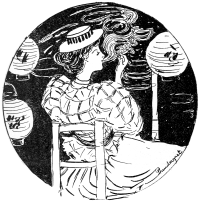 in her mouth. The house-boat Heathen Chinee lay but a
short distance off, and Scrymgeour could see the owner gazing after his
daughter placidly, a pipe between his lips.
in her mouth. The house-boat Heathen Chinee lay but a
short distance off, and Scrymgeour could see the owner gazing after his
daughter placidly, a pipe between his lips.
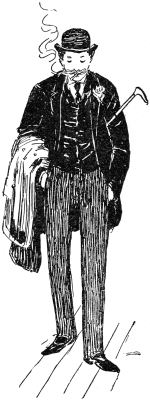 quarrelled so quickly, but it was about
some one whom he called 'that fellow,' while she called him a 'friend of
papa's.' He looked at her for a long time again, and then said coldly
that he wished her a very good-evening. She bowed and went toward a
house, humming a merry air, while he pretended to light a cigarette made
from a tobacco of which he was very fond. Till very late that night I
heard him walking up and down the deck of the house-boat, his friend
shouting to him not to be an ass. Me he had flung fiercely on the floor
of the house-boat.
About midnight he came downstairs, his face white, and, snatching me up,
put me in his pocket. Again we went into the punt, and he pushed it
within sight of the garden. There he pulled in his pole and lay
quarrelled so quickly, but it was about
some one whom he called 'that fellow,' while she called him a 'friend of
papa's.' He looked at her for a long time again, and then said coldly
that he wished her a very good-evening. She bowed and went toward a
house, humming a merry air, while he pretended to light a cigarette made
from a tobacco of which he was very fond. Till very late that night I
heard him walking up and down the deck of the house-boat, his friend
shouting to him not to be an ass. Me he had flung fiercely on the floor
of the house-boat.
About midnight he came downstairs, his face white, and, snatching me up,
put me in his pocket. Again we went into the punt, and he pushed it
within sight of the garden. There he pulled in his pole and lay
 plank. In parties of two and three a number of tourists strolled down
the path; but they were all afraid to cross the bridge. I saw them test
it with their alpenstocks; but none would put more than one foot on it.
They gathered there at their wit's end.
plank. In parties of two and three a number of tourists strolled down
the path; but they were all afraid to cross the bridge. I saw them test
it with their alpenstocks; but none would put more than one foot on it.
They gathered there at their wit's end.
 "Do you know Tirano, a hamlet in a nest of vines, where Italian soldiers
strut and women sleep in the sun beside baskets of fruit? How happily we
entered it; were we the same persons who left it within an hour? I was
now travelling with her party; and at Tirano, while the others rested,
she and I walked down a road between vines and Indian corn. Why I should
then have told her that I loved her for a whole day before she saw me
I cannot tell. It may have been something she said, perhaps only an
irresistible movement of her head; for her grace was ever taking me by
surprise, and she was a revelation a thousand times a day. But whatever
it was that made me speak out, I suddenly told her that I fell in love
with her as she stood upon the plank at Franzenshohe. I remember her
stopping short at a point where there had probably once been a gate to
the vineyard, and I thought she was angry with me for not having told
her of the Franzenshohe incident before. Soon the pallor of her face
alarmed me. She entreated me to say it was not at Franzenshohe that I
first loved her, and I fancied she was afraid lest her behavior on the
bridge had
"Do you know Tirano, a hamlet in a nest of vines, where Italian soldiers
strut and women sleep in the sun beside baskets of fruit? How happily we
entered it; were we the same persons who left it within an hour? I was
now travelling with her party; and at Tirano, while the others rested,
she and I walked down a road between vines and Indian corn. Why I should
then have told her that I loved her for a whole day before she saw me
I cannot tell. It may have been something she said, perhaps only an
irresistible movement of her head; for her grace was ever taking me by
surprise, and she was a revelation a thousand times a day. But whatever
it was that made me speak out, I suddenly told her that I fell in love
with her as she stood upon the plank at Franzenshohe. I remember her
stopping short at a point where there had probably once been a gate to
the vineyard, and I thought she was angry with me for not having told
her of the Franzenshohe incident before. Soon the pallor of her face
alarmed me. She entreated me to say it was not at Franzenshohe that I
first loved her, and I fancied she was afraid lest her behavior on the
bridge had
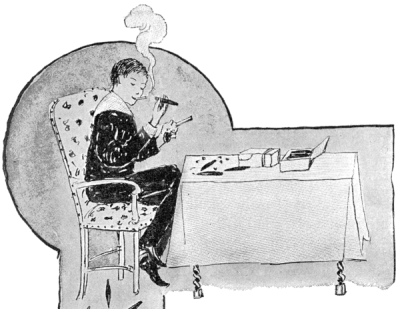
 tyrant Poppy, and they practised walking
the plank at Scrymgeour's window. The plank was pushed nearly half-way
out at the window, and you walked up it until it toppled and you were
flung into the quadrangle. Such was the romance of William John that he
walked the plank with his arms tied, shouting scornfully, by request,
"Captain Kidd, I defy you! ha, ha! the buccaneer does not live who
will blanch the cheeks of Dick, the Doughty Tar!" Then William John
disappeared, and had to be put in poultices.
tyrant Poppy, and they practised walking
the plank at Scrymgeour's window. The plank was pushed nearly half-way
out at the window, and you walked up it until it toppled and you were
flung into the quadrangle. Such was the romance of William John that he
walked the plank with his arms tied, shouting scornfully, by request,
"Captain Kidd, I defy you! ha, ha! the buccaneer does not live who
will blanch the cheeks of Dick, the Doughty Tar!" Then William John
disappeared, and had to be put in poultices.
 was more, he would "cheek" his master for imposing it; and I also
heard that he and Johnny had some thought of writing the essay in
a form suggested by their perusal of the "Comic History of Rome."
One day I found a paper in my chambers which told me that the task was
nevertheless receiving serious consideration. It was the instructions
given by Primus's master with regard to the essay, which was to be "in
the form of a letter," and "not less than five hundred words in length."
The writer, it was suggested, should give a general sketch of how he was
passing his time, what books he was reading, and "how he was making the
home brighter." I did not know that Primus had risen equal to the
occasion until one day after his departure,
was more, he would "cheek" his master for imposing it; and I also
heard that he and Johnny had some thought of writing the essay in
a form suggested by their perusal of the "Comic History of Rome."
One day I found a paper in my chambers which told me that the task was
nevertheless receiving serious consideration. It was the instructions
given by Primus's master with regard to the essay, which was to be "in
the form of a letter," and "not less than five hundred words in length."
The writer, it was suggested, should give a general sketch of how he was
passing his time, what books he was reading, and "how he was making the
home brighter." I did not know that Primus had risen equal to the
occasion until one day after his departure,
 days during the hollidays; and my first
way of spending my days during the hollidays is whatsoever my hands find
to do doing it with all my might; also setting my face nobly against
hurting the fealings of others, and minding to say, before I go to
sleep, 'Something attempted, something done, to earn a night's repose,'
as advised by you, my esteemed communicant. I spend my days during the
hollidays getting up early, so as to be down in time for breakfast, and
not to give no trouble. At breakfast I behave like a model, so as to set
a good example; and then I go out for a walk with my esteemed young
friend, John Fox, whom I chose carefully for a friend, fearing to
corrupt my morals by holding communications with rude boys. The J. Fox
whom I mentioned is esteemed by all who knows him as of a unusually
gentle disposition;
days during the hollidays; and my first
way of spending my days during the hollidays is whatsoever my hands find
to do doing it with all my might; also setting my face nobly against
hurting the fealings of others, and minding to say, before I go to
sleep, 'Something attempted, something done, to earn a night's repose,'
as advised by you, my esteemed communicant. I spend my days during the
hollidays getting up early, so as to be down in time for breakfast, and
not to give no trouble. At breakfast I behave like a model, so as to set
a good example; and then I go out for a walk with my esteemed young
friend, John Fox, whom I chose carefully for a friend, fearing to
corrupt my morals by holding communications with rude boys. The J. Fox
whom I mentioned is esteemed by all who knows him as of a unusually
gentle disposition;
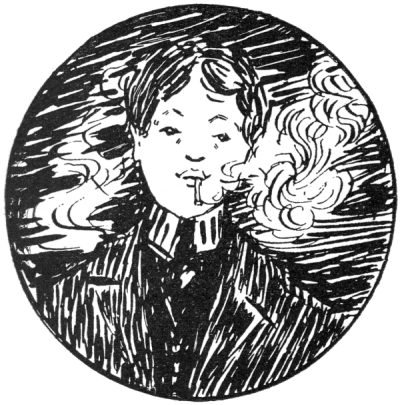
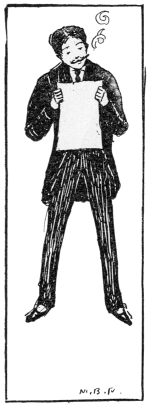
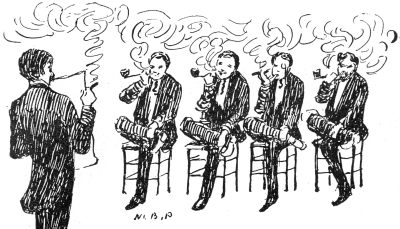
 if my health does not break down with
overpressure. Perhaps if you bought the two you would get them for 6s.
6d. Or what do you say to the housekeeper's giving me a shilling of it,
and not sending the neckties?
if my health does not break down with
overpressure. Perhaps if you bought the two you would get them for 6s.
6d. Or what do you say to the housekeeper's giving me a shilling of it,
and not sending the neckties?
| Nominal Price. | Price Paid. | ||||
| £ | s. | d. | s. | d. | |
| 1850 "Sunshine and Shadow" ... | 0 | 2 | 0 | 1 | 6 |
| 1881 "Honesty Jack" ... | 0 | 2 | 0 | 1 | 6 |
| 1882 "The Boy Makes the Man" ... | 0 | 3 | 6 | 2 | 7½ |
| 1883 "Great Explorers" ... | 0 | 3 | 6 | 2 | 7½ |
| 1884 "Shooting the Rapids" ... | 0 | 3 | 6 | 2 | 7½ |
| 1885 "The Boy Voyagers" ... | 0 | 5 | 0 | 3 | 9 |
| 1886 "The Formation of Character"... | 0 | 6 | 0 | 4 | 6 |
| | | ||||
| 1 | 5 | 6 | 19 | 1½ | |
| 0 | 19 | 1½ | |||
| | |||||
| 0 | 6 | 4½ | |||
Thus 6s. 4½d. is the exact sum. The best plan will be for you not to buy anything for me till I get my holidays, when my father is to bring me to London. Tell William John I am coming.
P.S.—I told my father about the Arcadia Mixture, and that is why he is coming to London.
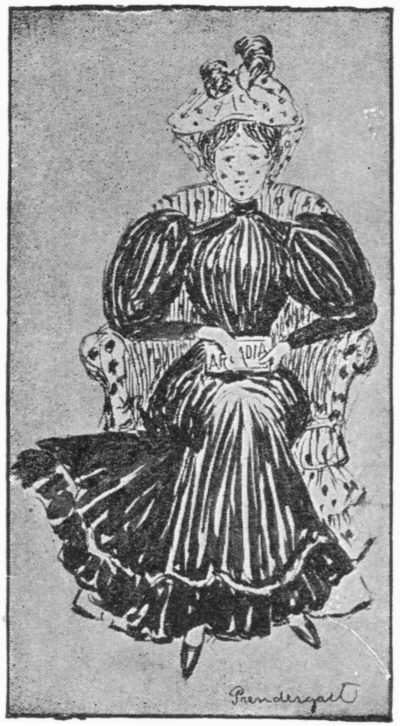
CHAPTER XXI.
ENGLISH-GROWN TOBACCO.
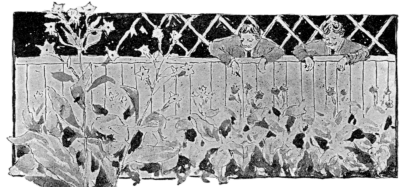
Pettigrew asked me to come to his house one evening and test some tobacco that had been grown in his brother's Devonshire garden. I had so far had no opportunity of judging for myself whether this attempt to grow tobacco on English soil was to succeed. Very complimentary was Pettigrew's assertion that he had restrained himself from trying the tobacco until we could test it in company. At the dinner-table while Mrs. Pettigrew was present we managed to talk for a time of other matters; but the tobacco was on our minds, and [pg 178] I was glad to see that, despite her raillery, my hostess had a genuine interest in the coming experiment. She drew an amusing picture, no doubt a little exaggerated, of her husband's difficulty in refraining from testing the tobacco until my arrival, declaring that every time she entered the smoking-room she found him staring at it. Pettigrew took this in good part, and informed me that she had carried the tobacco several times into the drawing-room to show it proudly to her friends. He was very delighted, he said, that I was to remain over night, as that would give us a long evening to test the tobacco thoroughly. A neighbor of his had also been experimenting; and Pettigrew, who has a considerable sense of humor, told me a diverting story about this gentleman and his friends having passed judgment on home-grown tobacco after smoking one pipe of it! We were laughing over the ridiculously unsatisfactory character of this test (so called) when we adjourned to the smoking-room. Before we did so Mrs. Pettigrew bade me good-night. She had also left strict orders with the servants that we were on no account to be disturbed.
As soon as we were comfortably seated in our smoking-chairs, which takes longer than some people think, Pettigrew offered me a [pg 179] Cabana. I would have preferred to begin at once with the tobacco; but of course he was my host, and I put myself entirely in his hands. I noticed that, from the moment his wife left us, he was a little excited, talking more than is his wont. He seemed to think that he was not doing his duty as a host if the conversation flagged for a moment, and what was still more curious, he spoke of everything except his garden tobacco. I emphasize this here at starting, lest any one should think that I was in any way responsible for the manner in which our experiment was conducted. If fault there was, it lies at Pettigrew's door. I remember distinctly asking him—not in a half-hearted way, but boldly—to produce his tobacco. I did this at an early hour of the proceedings, immediately after I had lighted a second cigar. The reason I took that cigar will be obvious to every gentleman who smokes. Had I declined it, Pettigrew might have thought that I disliked the brand, which would have been painful to him. However, he did not at once bring out the tobacco; indeed, his precise words, I remember, were that we had lots of time. As his guest I could not press him further.
Pettigrew smokes more quickly than I do, and he had reached the end of his second cigar [pg 180] when there was still five minutes of mine left. It distresses me to have to say what followed. He hastily lighted a third cigar, and then, unlocking a cupboard, produced about two ounces of his garden tobacco. His object was only too plain. Having just begun a third cigar he could not be expected to try the tobacco at present, but there was nothing to prevent my trying it. I regarded Pettigrew rather contemptuously, and then I looked with much interest at the tobacco. It was of an inky color. When I looked up I caught Pettigrew's eye on me. He withdrew it hurriedly, but soon afterward I saw him looking in the same sly way again. There was a rather painful silence for a time, and then he asked me if I had anything to say. I replied firmly that I was looking forward to trying the tobacco with very great interest. By this time my cigar was reduced to a stump, but, for reasons that Pettigrew misunderstood, I continued to smoke it. Somehow our chairs had got out of position now, and we were sitting with our backs to each other. I felt that Pettigrew was looking at me covertly over his shoulder, and took a side glance to make sure of this. Our eyes met, and I bit my lip. If there is one thing I loathe, it is to be looked at in this shame-faced manner.
I continued to smoke the stump of my cigar until it scorched my under-lip, and at intervals Pettigrew said, without looking round, that my cigar seemed everlasting. I treated his innuendo with contempt; but at last I had to let the cigar-end go. Not to make a fuss, I dropped it very quietly; but Pettigrew must have been listening for the sound. He wheeled round at once, and pushed the garden tobacco toward me. Never, perhaps, have I thought so little of him as at that moment. My indignation probably showed in my face, for he drew back, saying that he thought I "wanted to try it." Now I had never said that I did not want to try it. The reader has seen that I went to Pettigrew's house solely with the object of trying the tobacco. Had Pettigrew, then, any ground for insinuating that I did not mean to try it? Restraining my passion, I lighted a third cigar, and then put the question to him bluntly. Did he, or did he not, mean to try that tobacco? I dare say I was a little brusque; but it must be remembered that I had come all the way from the inn, at considerable inconvenience, to give the tobacco a thorough trial.
As is the way with men of Pettigrew's type, when you corner them, he
attempted to put the blame on me. "Why had I not tried the tobacco,"
[pg 182]
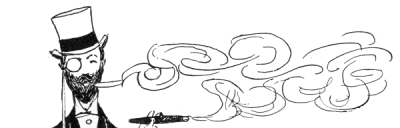
 he asked, "instead of taking a third cigar?" For reply, I asked bitingly
if that was not his third cigar. He admitted it was, but said that he
smoked more quickly than I did, as if that put his behavior in a more
favorable light. I smoked my third cigar very slowly, not because I
wanted to put off the experiment; for, as every one must have noted,
I was most anxious to try it, but just to see what would happen. When
Pettigrew had finished his cigar—and I thought he would never be done
with it—he gazed at the garden tobacco for a time, and then took a pipe
from the mantelpiece. He held it first in one hand, then in the other,
and then he brightened up and said he would clean his pipes.
[pg 183]
This he did
very slowly. When he had cleaned all his pipes he again looked at the
garden tobacco, which I pushed toward him. He glared at me as if I had
not been doing a friendly thing, and then said, in an apologetic manner,
that he would smoke a pipe until my cigar was finished. I said "All
right" cordially, thinking that he now meant to begin the experiment;
but conceive my feelings when he produced a jar of the Arcadia Mixture.
He filled his pipe with this and proceeded to light it, looking at me
defiantly. His excuse about waiting till I had finished was too pitiful
to take notice of. I finished my cigar in a few minutes, and now was the
time when I would have liked to begin the experiment. As Pettigrew's
guest, however, I could not take that liberty, though he impudently
pushed the garden tobacco toward me. I produced my pipe, my intention
being only to half fill it with Arcadia, so that Pettigrew and I might
finish our pipes at the same time. Custom, however, got the better of
me, and inadvertently I filled my pipe, only noticing this when it was
too late to remedy the mistake. Pettigrew thus finished before me; and
though I advised him to begin on the garden tobacco without waiting for
me, he insisted on smoking half a pipeful of Arcadia, just to
[pg 184]
keep me
company. It was an extraordinary thing that, try as we might, we could
not finish our pipes at the same time.
he asked, "instead of taking a third cigar?" For reply, I asked bitingly
if that was not his third cigar. He admitted it was, but said that he
smoked more quickly than I did, as if that put his behavior in a more
favorable light. I smoked my third cigar very slowly, not because I
wanted to put off the experiment; for, as every one must have noted,
I was most anxious to try it, but just to see what would happen. When
Pettigrew had finished his cigar—and I thought he would never be done
with it—he gazed at the garden tobacco for a time, and then took a pipe
from the mantelpiece. He held it first in one hand, then in the other,
and then he brightened up and said he would clean his pipes.
[pg 183]
This he did
very slowly. When he had cleaned all his pipes he again looked at the
garden tobacco, which I pushed toward him. He glared at me as if I had
not been doing a friendly thing, and then said, in an apologetic manner,
that he would smoke a pipe until my cigar was finished. I said "All
right" cordially, thinking that he now meant to begin the experiment;
but conceive my feelings when he produced a jar of the Arcadia Mixture.
He filled his pipe with this and proceeded to light it, looking at me
defiantly. His excuse about waiting till I had finished was too pitiful
to take notice of. I finished my cigar in a few minutes, and now was the
time when I would have liked to begin the experiment. As Pettigrew's
guest, however, I could not take that liberty, though he impudently
pushed the garden tobacco toward me. I produced my pipe, my intention
being only to half fill it with Arcadia, so that Pettigrew and I might
finish our pipes at the same time. Custom, however, got the better of
me, and inadvertently I filled my pipe, only noticing this when it was
too late to remedy the mistake. Pettigrew thus finished before me; and
though I advised him to begin on the garden tobacco without waiting for
me, he insisted on smoking half a pipeful of Arcadia, just to
[pg 184]
keep me
company. It was an extraordinary thing that, try as we might, we could
not finish our pipes at the same time.
About 2 A.M. Pettigrew said something about going to bed; and I rose and put down my pipe. We stood looking at the fireplace for a time, and he expressed regret that I had to leave so early in the morning. Then he put out two of the lights, and after that we both looked at the garden tobacco. He seemed to have a sudden idea; for rather briskly he tied the tobacco up into a neat paper parcel and handed it to me, saying that I would perhaps give it a trial at the inn. I took it without a word, but opening my hand suddenly I let it fall. My first impulse was to pick it up; but then it struck me that Pettigrew had not noticed what had happened, and that, were he to see me pick it up, he might think that I had not taken sufficient care of it. So I let it lie, and, bidding him good-night, went off to bed. I was at the foot of the stair when I thought that, after all, I should like the tobacco, so I returned. I could not see the package anywhere, but something was fizzing up the chimney, and Pettigrew had the tongs in his hand. He muttered something about his wife taking up wrong notions. Next morning that lady was very satirical [pg 185] about our having smoked the whole two ounces.
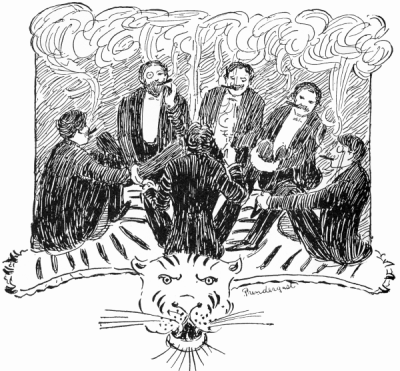
CHAPTER XXII.
HOW HEROES SMOKE.
On a tiger-skin from the ice-clad regions of the sunless north recline the heroes of Ouida, rose-scented cigars in their mouths; themselves gloriously indolent and disdainful, but perhaps huddled a little too closely together on account of the limited accommodation. Strathmore is here. But I never felt sure of Strathmore. Was there not less in him than met the eye? [pg 187] His place, Whiteladies, was a home for kings and queens; but he was not the luxurious, magnanimous creature he feigned to be. A host may be known by the cigars he keeps; and, though it is perhaps a startling thing to say, we have good reason for believing that Strathmore did not buy good cigars. I question very much whether he had many Havanas, even of the second quality, at Whiteladies; if he had, he certainly kept them locked up. Only once does he so much as refer to them when at his own place, and then in the most general and suspicious way. "Bah!" he exclaims to a friend; "there is Phil smoking these wretched musk-scented cigarettes again! they are only fit for Lady Georgie or Eulalie Papellori. What taste, when there are my Havanas and cheroots!" The remark, in whatever way considered, is suggestive. In the first place, it is made late in the evening, after Strathmore and his friend have left the smoking-room. Thus it is a safe observation. I would not go so far as to say that he had no Havanas in the house; the likelihood is that he had a few in his cigar-case, kept there for show rather than use. These, if I understand the man, would be a good brand, but of small size—perhaps Reinas—and they would hardly be of a well-known crop. In [pg 188] color they would be dark—say maduro—and he would explain that he bought them because he liked full-flavored weeds. Possibly he had a Villar y Villar box with six or eight in the bottom of it; but boxes are not cigars. What he did provide his friends with was Manillas. He smoked them himself, and how careful he was of them is seen on every other page. He is constantly stopping in the middle of his conversation to "curl a loose leaf round his Manilla;" when one would have expected a hero like Strathmore to fling away a cigar when its leaves began to untwist, and light another. So thrifty is Strathmore that he even laboriously "curls the leaves round his cigarettes"—he does not so much as pretend that they are Egyptian; nay, even when quarrelling with Errol, his beloved friend (whom he shoots through the heart), he takes a cigarette from his mouth and "winds a loosened leaf" round it.
 If Strathmore's Manillas were Capitan Generals they would cost him about
24s. a hundred. The probability, however, is that they were of inferior
quality; say, 17s. 6d. It need hardly be said that a good Manilla does
not constantly require to have its leaves "curled." When Errol goes into
the garden to smoke, he has every other minute to "strike a fusee;" from
[pg 189]
which it may be inferred that his cigar frequently goes out. This is
in itself suspicious. Errol, too, is more than once seen by his host
wandering in the grounds at night, with a cigar between his teeth.
Strathmore thinks his susceptible friend has a love affair on hand; but
is
it not at least as probable an explanation that Errol had a private
supply of cigars at Whiteladies, and from motives of delicacy did not
like to smoke them in his host's presence? Once, indeed, we do see
Strathmore smoking a good cigar, though we are not told how he came by
it. When talking of the Vavasour, he "sticks his penknife through his
Cabana," with the object, obviously, of smoking it to the bitter end.
Another lady novelist, who is also an authority on tobacco, Miss Rhoda
Broughton, contemptuously dismisses a claimant for the heroship of one
of her stories, as the kind of man who turns up his trousers at the
foot. It would have been just as withering to say that he stuck a
penknife through his cigars.
If Strathmore's Manillas were Capitan Generals they would cost him about
24s. a hundred. The probability, however, is that they were of inferior
quality; say, 17s. 6d. It need hardly be said that a good Manilla does
not constantly require to have its leaves "curled." When Errol goes into
the garden to smoke, he has every other minute to "strike a fusee;" from
[pg 189]
which it may be inferred that his cigar frequently goes out. This is
in itself suspicious. Errol, too, is more than once seen by his host
wandering in the grounds at night, with a cigar between his teeth.
Strathmore thinks his susceptible friend has a love affair on hand; but
is
it not at least as probable an explanation that Errol had a private
supply of cigars at Whiteladies, and from motives of delicacy did not
like to smoke them in his host's presence? Once, indeed, we do see
Strathmore smoking a good cigar, though we are not told how he came by
it. When talking of the Vavasour, he "sticks his penknife through his
Cabana," with the object, obviously, of smoking it to the bitter end.
Another lady novelist, who is also an authority on tobacco, Miss Rhoda
Broughton, contemptuously dismisses a claimant for the heroship of one
of her stories, as the kind of man who turns up his trousers at the
foot. It would have been just as withering to say that he stuck a
penknife through his cigars.
There is another true hero with me, whose
[pg 190]

 creator has unintentionally
misrepresented him. It is he of "Comin' thro' the Rye," a gentleman whom
the maidens of the nineteenth century will not willingly let die. He is
grand, no doubt; and yet, the more one thinks about him, the plainer it
becomes that had the heroine married him she would have been bitterly
disenchanted. In her company he was magnanimous; god-like, prodigal;
but in his smoking-room he showed himself in his true colors. Every
lady will remember the scene where he rushes to the heroine's home and
implores her to return with him to the bedside of his dying wife. The
sudden announcement that his wife—whom he had thought in a good state
of health—is dying, is surely enough to startle even a miser out of his
niggardliness, much less a hero; and yet what do we find Vasher doing?
The heroine, in frantic excitement, has to pass through his smoking
room, and on the table she sees—what? "A half-smoked cigar." He was in
the middle of it when a servant came to
[pg 191]
tell him of his wife's dying
request; and, before hastening to execute her wishes, he carefully
laid what was left of his cigar upon the table—meaning, of course, to
relight it when he came back. Though she did not think so, our heroine's
father was a much more remarkable man than Vasher. He "blew out long,
comfortable clouds" that made the whole of his large family "cough and
wink again." No ordinary father could do that.
creator has unintentionally
misrepresented him. It is he of "Comin' thro' the Rye," a gentleman whom
the maidens of the nineteenth century will not willingly let die. He is
grand, no doubt; and yet, the more one thinks about him, the plainer it
becomes that had the heroine married him she would have been bitterly
disenchanted. In her company he was magnanimous; god-like, prodigal;
but in his smoking-room he showed himself in his true colors. Every
lady will remember the scene where he rushes to the heroine's home and
implores her to return with him to the bedside of his dying wife. The
sudden announcement that his wife—whom he had thought in a good state
of health—is dying, is surely enough to startle even a miser out of his
niggardliness, much less a hero; and yet what do we find Vasher doing?
The heroine, in frantic excitement, has to pass through his smoking
room, and on the table she sees—what? "A half-smoked cigar." He was in
the middle of it when a servant came to
[pg 191]
tell him of his wife's dying
request; and, before hastening to execute her wishes, he carefully
laid what was left of his cigar upon the table—meaning, of course, to
relight it when he came back. Though she did not think so, our heroine's
father was a much more remarkable man than Vasher. He "blew out long,
comfortable clouds" that made the whole of his large family "cough and
wink again." No ordinary father could do that.
Among my smoking-room favorites is the hero of Miss Adeline Sergeant's story, "Touch and Go." He is a war correspondent; and when he sees a body of the enemy bearing down upon him and the wounded officer whom he has sought to save, he imperturbably offers his companion a cigar. They calmly smoke on while the foe gallop up. There is something grand in this, even though the kind of cigar is not mentioned.
I see a bearded hero, with slouch hat and shepherd's crook, a clay pipe
in his mouth. He is a Bohemian—ever a popular type of hero; and the
Bohemian is to be known all the world over by the pipe, which he prefers
to a cigar. The tall, scornful gentleman who leans lazily against the
door, "blowing great clouds of smoke into the air," is the hero of a
hundred novels.
[pg 192]
 That is how he is always standing when the heroine,
having need of something she has left in the drawing-room, glides down
the stairs at night in her dressing-gown (her beautiful hair, released
from its ribbons, streaming down her neck and shoulders), and comes most
unexpectedly upon him. He is young. The senior, over whose face "a smile
flickers for a moment" when the heroine says something naïve, and whom
she (entirely misunderstanding her feelings) thinks she hates, smokes
unostentatiously; but though a little inclined to quiet "chaff," he is a
man of deep feeling. By and by he will open out and gather her up in his
arms. The scorner's chair is filled. I see him, shadow-like, a sad-eyed,
blasé gentleman, who has been adored by all the beauties of
fifteen seasons, and yet speaks of woman with a contemptuous sneer.
Great, however, is love; and the vulgar little girl who talks slang will
prove to him in our next volume that there is still one peerless beyond
all others of her sex. Ah, a
[pg 193]
wondrous thing is love! On every side of
me there are dark, handsome men, with something sinister in their smile,
"casting away their cigars with a muffled curse." No novel would be
complete without them. When they are foiled by the brave girl of the
narrative, it is the recognized course with them to fling away their
cigars with a muffled curse. Any kind of curse would do, but muffled
ones are preferred.
That is how he is always standing when the heroine,
having need of something she has left in the drawing-room, glides down
the stairs at night in her dressing-gown (her beautiful hair, released
from its ribbons, streaming down her neck and shoulders), and comes most
unexpectedly upon him. He is young. The senior, over whose face "a smile
flickers for a moment" when the heroine says something naïve, and whom
she (entirely misunderstanding her feelings) thinks she hates, smokes
unostentatiously; but though a little inclined to quiet "chaff," he is a
man of deep feeling. By and by he will open out and gather her up in his
arms. The scorner's chair is filled. I see him, shadow-like, a sad-eyed,
blasé gentleman, who has been adored by all the beauties of
fifteen seasons, and yet speaks of woman with a contemptuous sneer.
Great, however, is love; and the vulgar little girl who talks slang will
prove to him in our next volume that there is still one peerless beyond
all others of her sex. Ah, a
[pg 193]
wondrous thing is love! On every side of
me there are dark, handsome men, with something sinister in their smile,
"casting away their cigars with a muffled curse." No novel would be
complete without them. When they are foiled by the brave girl of the
narrative, it is the recognized course with them to fling away their
cigars with a muffled curse. Any kind of curse would do, but muffled
ones are preferred.
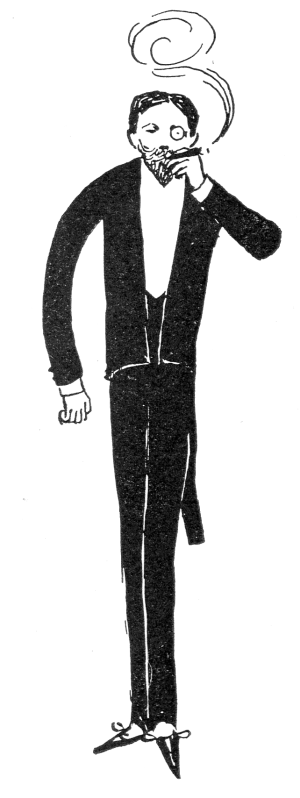
CHAPTER XXIII.
THE GHOST OF CHRISTMAS EVE.
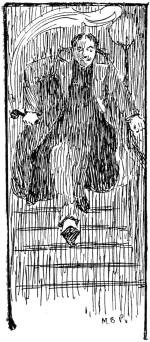
A few years ago, as some may remember, a startling ghost-paper appeared in the monthly organ of the Society for Haunting Houses. The writer guaranteed the truth of his statement, and even gave the name of the Yorkshire manor-house in which the affair took place. The article and the discussion to which it gave rise agitated me a good deal, and I consulted Pettigrew about the advisability of clearing up the mystery. The writer wrote that he "distinctly saw his arm pass through the apparition and come out at the other side," and indeed I still remember his saying so next morning. He had a scared face, but I had presence of mind to continue eating my rolls and marmalade as if my brier had nothing to do with the miraculous affair.
[pg 195]


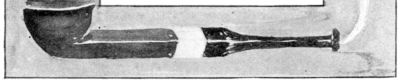 Seeing that he made a "paper" of it, I suppose he is justified in
touching up the incidental details. He says, for instance, that we were
told the story of the ghost which is said to haunt the house, just
before going to bed. As far as I remember, it was only mentioned at
luncheon, and then sceptically. Instead of there being snow falling
outside and an eerie wind wailing through the skeleton trees, the night
was still and muggy.
Seeing that he made a "paper" of it, I suppose he is justified in
touching up the incidental details. He says, for instance, that we were
told the story of the ghost which is said to haunt the house, just
before going to bed. As far as I remember, it was only mentioned at
luncheon, and then sceptically. Instead of there being snow falling
outside and an eerie wind wailing through the skeleton trees, the night
was still and muggy.
Lastly, I did not know, until the journal reached my hands, that he was put [pg 196] into the room known as the Haunted Chamber, nor that in that room the fire is noted for casting weird shadows upon the walls. This, however, may be so. The legend of the manor-house ghost he tells precisely as it is known to me. The tragedy dates back to the time of Charles I., and is led up to by a pathetic love-story, which I need not give. Suffice it that for seven days and nights the old steward had been anxiously awaiting the return of his young master and mistress from their honeymoon. On Christmas eve, after he had gone to bed, there was a great clanging of the door-bell. Flinging on a dressing-gown, he hastened downstairs. According to the story, a number of servants watched him, and saw by the light of his candle that his face was an ashy white. He took off the chains of the door, unbolted it, and pulled it open. What he saw no human being knows; but it must have been something awful, for, without a cry, the old steward fell dead in the hall. Perhaps the strangest part of the story is this: that the shadow of a burly man, holding a pistol in his hand, entered by the open door, stepped over the steward's body, and, gliding up the stairs, disappeared, no one could say where. Such is the legend. I shall not tell the many ingenious explanations of it that [pg 197] have been offered. Every Christmas eve, however, the silent scene is said to be gone through again; and tradition declares that no person lives for twelve months at whom the ghostly intruder points his pistol.

On Christmas Day the gentleman who tells the tale in a scientific journal created some sensation at the breakfast-table by solemnly asserting that he had seen the ghost. Most of the men present scouted his story, which may be condensed into a few words. He had retired to his bedroom at a fairly early hour, and as he opened the door his candle-light was blown out. He tried to get a light from the fire, but it was too low, and eventually he went to bed in the semi-darkness. He was wakened—he did not know at what hour—by the clanging of a bell. He sat up in bed, and the ghost-story came in a rush to his mind. His fire was dead, and the room was consequently dark; yet by and by he knew, though he heard no sound, that his door had opened. He cried out, "Who is that?" but got no answer. By an effort he jumped up and went to the door, which was ajar. His bedroom was on the first floor, and looking up the stairs he could see nothing. He felt a cold sensation at his heart, however, when he looked the other way. Going slowly and without a [pg 198] sound down the stairs, was an old man in a dressing-gown. He carried a candle. From the top of the stairs only part of the hall is visible, but as the apparition disappeared the watcher had the courage to go down a few steps after him. At first nothing was to be seen, for the candle-light had vanished. A dim light, however, entered by the long, narrow windows which flank the hall door, and after a moment the on-looker could see that the hall was empty. He was marvelling at this sudden disappearance of the steward, when, to his horror, he saw a body fall upon the hall floor within a few feet of the door. The watcher cannot say whether he cried out, nor how long he stood there trembling. He came to himself with a start as he realized that something was coming up the stairs. Fear prevented his taking flight, and in a moment the thing was at his side. Then he saw indistinctly that it was not the figure he had seen descend. He saw a younger man, in a heavy overcoat, but with no hat on his head. He wore on his face a look of extravagant triumph. The guest boldly put out his hand toward the figure. To his amazement his arm went through it. The ghost paused for a moment and looked behind it. It was then the watcher realized that it carried a pistol in its [pg 199] right hand. He was by this time in a highly strung condition, and he stood trembling lest the pistol should be pointed at him. The apparition, however, rapidly glided up the stairs and was soon lost to sight. Such are the main facts of the story, none of which I contradicted at the time.
I cannot say absolutely that I can clear up this mystery, but my suspicions are confirmed by a good deal of circumstantial evidence. This will not be understood unless I explain my strange infirmity. Wherever I went I used to be troubled with a presentiment that I had left my pipe behind. Often, even at the dinner-table, I paused in the middle of a sentence as if stricken with sudden pain. Then my hand went down to my pocket. Sometimes even after I felt my pipe, I had a conviction that it was stopped, and only by a desperate effort did I keep myself from producing it and blowing down it. I distinctly remember once dreaming three nights in succession that I was on the Scotch express without it. More than once, I know, I have [pg 200] wandered in my sleep, looking for it in all sorts of places, and after I went to bed I generally jumped out, just to make sure of it. My strong belief, then, is that I was the ghost seen by the writer of the paper. I fancy that I rose in my sleep, lighted a candle, and wandered down to the hall to feel if my pipe was safe in my coat, which was hanging there. The light had gone out when I was in the hall. Probably the body seen to fall on the hall floor was some other coat which I had flung there to get more easily at my own. I cannot account for the bell; but perhaps the gentleman in the Haunted Chamber dreamed that part of the affair. I had put on the overcoat before reascending; indeed I may say that next morning [pg 201] I was surprised to find it on a chair in my bedroom, also to notice that there were several long streaks of candle-grease on my dressing-gown. I conclude that the pistol, which gave my face such a look of triumph, was my brier, which I found in the morning beneath my pillow. The strangest thing of all, perhaps, is that when I awoke there was a smell of tobacco-smoke in the bedroom.
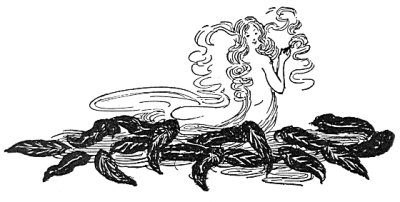
CHAPTER XXIV.
NOT THE ARCADIA.
Those who do not know the Arcadia may have a mixture that their uneducated palate loves, but they are always ready to try other mixtures. The Arcadian, however, will never help himself from an outsider's pouch. Nevertheless, there was one black week when we all smoked the ordinary tobaccoes. Owing to a terrible oversight on the part of our purveyor, there was no Arcadia to smoke.
We ought to have put our pipes aside and existed on cigars; but the pipes were old friends, and desert them we could not. Each of us bought a different mixture, but they tasted alike and were equally abominable. I fell ill. Doctor Southwick, knowing no better, called my malady [pg 203] by a learned name, but I knew to what I owed it. Never shall I forget my delight when Jimmy broke into my room one day with a pound-tin of the Arcadia. Weak though I was, I opened my window and, seizing the half-empty packet of tobacco that had made me ill, hurled it into the street. The tobacco scattered before it fell, but I sat at the window gloating over the packet, which lay a dirty scrap of paper, where every cab might pass over it. What I call the street is more strictly a square, for my windows were at the back of the inn, and their view was somewhat plebeian. The square is the meeting-place of five streets, and at the corner of each the paper was caught up in a draught that bore it along to the next.
Here, it may be thought, I gladly forgot the cause of my troubles, but I really watched the paper for days. My doctor came in while I was still staring at it, and instead of prescribing more medicine, he made a bet with me. It was that the scrap of paper would disappear before the dissolution of the government. I said it would be fluttering around after the government was dissolved, and if I lost, the doctor was to get a new stethoscope. If I won, my bill was to be accounted discharged. Thus, strange as it seemed, I had now cause to take a friendly [pg 204] interest in paper that I had previously loathed. Formerly the sight of it made me miserable; now I dreaded losing it. But I looked for it when I rose in the morning, and I could tell at once by its appearance what kind of night it had passed. Nay, more: I believed I was able to decide how the wind had been since sundown, whether there had been much traffic, and if the fire-engine had been out. There is a fire-station within view of the windows, and the paper had a specially crushed appearance, as if the heavy engine ran over it. However, though I felt certain that I could pick my scrap of paper out of a thousand scraps, the doctor insisted on making sure. The bet was consigned to writing on the very piece of paper that suggested it. The doctor went out and captured it himself. On the back of it the conditions of the wager were formally drawn up and signed by both of us. Then we opened the window and the paper was cast forth again. The doctor solemnly promised not to interfere with it, and I gave him a convalescent's word of honor to report progress honestly.
Several days elapsed, and I no longer found time heavy on my hands. My attention was divided between two papers, the scrap in the square and my daily copy of the Times. Any [pg 205] morning the one might tell me that I had lost my bet, or the other that I had won it; and I hurried to the window fearing that the paper had migrated to another square, and hoping my Times might contain the information that the government was out. I felt that neither could last very much longer. It was remarkable how much my interest in politics had increased since I made this wager.
The doctor, I believe, relied chiefly on the
 scavengers. He thought they
were sure to pounce upon the scrap soon. I did not, however, see why
I should fear them. They came into the square so seldom, and stayed so
short a time when they did come, that I disregarded them. If the doctor
knew how much they kept away he might say I bribed them. But perhaps he
knew their ways. I got a fright one day from a dog. It was one of those
low-looking animals that infest the square occasionally in half-dozens,
but seldom alone. It ran up one of the side streets, and before I
realized what had happened it had the paper in its mouth. Then it stood
still and looked
[pg 206]
around. For me that was indeed a trying moment. I stood
at the window.
scavengers. He thought they
were sure to pounce upon the scrap soon. I did not, however, see why
I should fear them. They came into the square so seldom, and stayed so
short a time when they did come, that I disregarded them. If the doctor
knew how much they kept away he might say I bribed them. But perhaps he
knew their ways. I got a fright one day from a dog. It was one of those
low-looking animals that infest the square occasionally in half-dozens,
but seldom alone. It ran up one of the side streets, and before I
realized what had happened it had the paper in its mouth. Then it stood
still and looked
[pg 206]
around. For me that was indeed a trying moment. I stood
at the window.
The impulse seized me to fling open the sash and shake my fist at the brute; but luckily I remembered in time my promise to the doctor. I question if man was ever so interested in mongrel before. At one of the street corners there was a house to let, being meantime, as I had reason to believe, in the care of the wife of a police constable. A cat was often to be seen coming up from the area to lounge in the doorway. To that cat I firmly believe I owe it that I did not then lose my wager. Faithful animal! it came up to the door, it stretched itself; in the act of doing so it caught sight of the dog, and put up its back. The dog, resenting this demonstration of feeling, dropped the scrap of paper and made for the cat. I sank back into my chair.
There was a greater disaster to be recorded next day. A workingman in the square, looking about him for a pipe-light, espied the paper frisking near the curb-stone. He picked it up with the obvious intention of lighting it at the stove of a wandering vender of hot chestnuts who had just crossed the square. The workingman followed, twisting the paper as he went, when—good luck again—a young butcher [pg 207] almost ran into him, and the loafer, with true presence of mind, at once asked him for a match. At any rate a match passed between them; and, to my infinite relief, the paper was flung away.
I concealed the cause of my excitement from William John. He nevertheless wondered to see me run to the window every time the wind seemed to be rising, and getting anxious when it rained. Seeing that my health prevented my leaving the house, he could not make out why I should be so interested in the weather. Once I thought he was fairly on the scent. A sudden blast of wind had caught up the paper and whirled it high in the air. I may have uttered an ejaculation, for he came hurrying to the window. He found me pointing unwittingly to what was already a white speck sailing to the roof of the fire-station. "Is it a pigeon?" he asked. I caught at the idea. "Yes, a carrier-pigeon," I murmured in reply; "they sometimes, I believe, send messages to the fire-stations in that way." Coolly as I said this, I was conscious of grasping the window-sill in pure nervousness till the scrap began to flutter back into the square.
Next it was squeezed between two of the bars of a drain. That was the last I saw of it, [pg 208] and the following morning the doctor had won his stethoscope—only by a few hours, however, for the government's end was announced in the evening papers. My defeat discomfited me for a little, but soon I was pleased that I had lost. I would not care to win a bet over any mixture but the Arcadia.
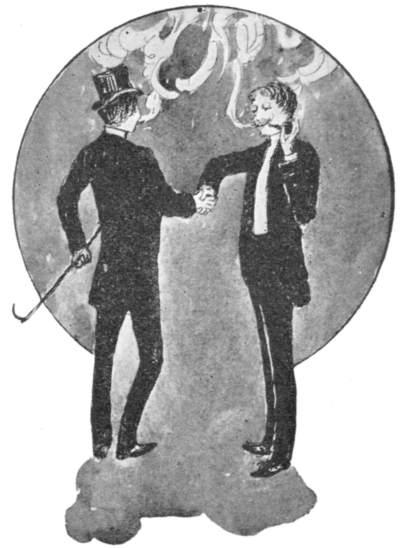
CHAPTER XXV.
A FACE THAT HAUNTED MARRIOT.
"This is not a love affair," Marriot shouted, apologetically.
He had sat the others out again, but when I saw his intention I escaped into my bedroom, and now refused to come out.
"Look here," he cried, changing his tone, "if you don't come out I'll tell you all about it through the keyhole. It is the most extraordinary story, and I can't keep it to myself. On [pg 210] my word of honor it isn't a love affair—at least not exactly."
I let him talk after I had gone to bed.
"You must know," he said, dropping cigarette ashes onto my pillow every minute, "that some time ago I fell in with Jack Goring's father, Colonel Goring. Jack and I had been David and Jonathan at Cambridge, and though we had not met for years, I looked forward with pleasure to meeting him again. He was a widower, and his father and he kept joint house. But the house was dreary now, for the colonel was alone in it. Jack was off on a scientific expedition to the Pacific; all the girls had been married for years. After dinner my host and I had rather a dull hour in the smoking-room. I could not believe that Jack had grown very stout. 'I'll show you his photograph,' said the colonel. An album was brought down from a dusty shelf, and then I had to admit that my old friend had become positively corpulent. But it is not Jack I want to speak about. I turned listlessly over the pages of the album, stopping suddenly at the face of a beautiful girl. You are not asleep, are you?
"I am not naturally sentimental, as you know, and even now I am not prepared to admit that I fell in love with this face. It was not, I think, [pg 211] that kind of attraction. Possibly I should have passed the photograph by had it not suggested old times to me—old times with a veil over them, for I could not identify the face. That I had at some period of my life known the original I felt certain, but I tapped my memory in vain. The lady was a lovely blonde, with a profusion of fair hair, and delicate features that were Roman when they were not Greek. To describe a beautiful woman is altogether beyond me. No doubt this face had faults. I fancy, for instance, that there was little character in the chin, and that the eyes were 'melting' rather than expressive. It was a vignette, the hands being clasped rather fancifully at the back of the head. My fingers drummed on the album as I sat there pondering; but when or where I had met the original I could not decide. The colonel could give me no information. The album was Jack's, he said, and probably had not been opened for years. The photograph, too, was an old one; he was sure it had been in the house long before his son's marriage, so that (and here the hard-hearted old gentleman chuckled) it could no longer be like the original. As he seemed inclined to become witty at my expense, I closed the album, and soon afterward I went away. I say, wake up!
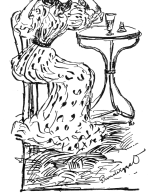
"From that evening the face haunted me. I do not mean that it possessed me to the exclusion of everything else, but at odd moments it would rise before me, and then I fell into a revery. You must have noticed my thoughtfulness of late. Often I have laid down my paper at the club and tried to think back to the original. She was probably better known to Jack Goring than to myself. All I was sure of was that she had been known to both of us. Jack and I had first met at Cambridge. I thought over the ladies I had known there, especially those who had been friends of Goring's. Jack had never been a 'lady's man' precisely; but, as he used to say, comparing himself with me, 'he had a heart.' The annals of our Cambridge days were searched in vain. I tried the country house in which he and I had spent a good many of [pg 213] our vacations. Suddenly I remembered the reading-party in Devonshire—but no, she was dark. Once Jack and I had a romantic adventure in Glencoe in which a lady and her daughter were concerned. We tried to make the most of it; but in our hearts we knew, after we had seen her by the morning light, that the daughter was not beautiful. Then there was the French girl at Algiers. Jack had kept me hanging on in Algiers a week longer than we meant to stay. The pose of the head, the hands clasped behind it, a trick so irritatingly familiar to me—was that the French girl? No, the lady I was struggling to identify was certainly English. I'm sure you're asleep.
"A month elapsed before I had an opportunity of seeing the photograph again. An idea had struck me which I meant to carry out. This was to trace the photograph by means of the photographer. I did not like, however, to mention the subject to Colonel Goring again, so I contrived to find the album while he was out of the smoking-room. The number of the photograph and the address of the photographer were all I wanted; but just as I had got the photograph out of the album my host returned. I slipped the thing quickly into my pocket, and he gave me no chance of replacing it. Thus it [pg 214] was owing to an accident that I carried the photograph away. My theft rendered me no assistance. True, the photographer's name and address were there; but when I went to the place mentioned it had disappeared to make way for 'residential chambers.' I have a few other Cambridge friends here, and I showed some of these the photograph. One, I am now aware, is under the impression that I am to be married soon, but the others were rational. Grierson, of the War Office, recognized the portrait at once. 'She is playing small parts at the Criterion,' he said. Finchley, who is a promising man at the bar, also recognized her. 'Her portraits were in all the illustrated papers five years ago,' he told me, 'at the time when she got twelve months.' They contradicted each other about her, however, and I satisfied myself that she was neither an actress at the Criterion nor the adventuress of 1883. It was, of course, conceivable that she was an actress, but if so her face was not known in the fancy stationers' windows. Are you listening ?
"I saw that the mystery would remain unsolved until Jack's return home; and when I had a letter from him a week ago, asking me to dine with him to-night, I accepted eagerly. He was just home, he said, and I would meet an [pg 215] old Cambridge man. We were to dine at Jack's club, and I took the photograph with me. I recognized Jack as soon as I entered the waiting-room of the club. A very short, very fat, smooth-faced man was sitting beside him, with his hands clasped behind his head. I believe I gasped. 'Don't you remember Tom Rufus,' Jack asked, 'who used to play the female part at the Cambridge A.D.C.? Why, you helped me to choose his wig at Fox's. I have a photograph of him in costume somewhere at home. You might recall him by his trick of sitting with his hands clasped behind his head.' I shook Rufus's hand. I went in to dinner, and probably behaved myself. Now that it is over I cannot help being thankful that I did not ask Jack for the name of the lady before I saw Rufus. Good-night. I think I've burned a hole in the pillow."
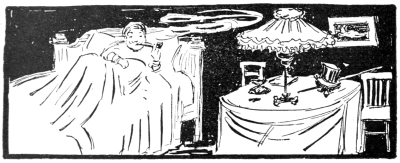
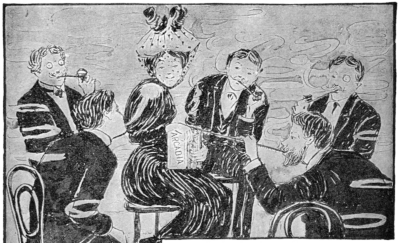
CHAPTER XXVI.
ARCADIANS AT BAY.
I have said that Jimmy spent much of his time in contributing to various leading waste-paper baskets, and that of an evening he was usually to be found prone on my hearth-rug. When he entered my room he was ever willing to tell us what he thought of editors, but his meerschaum with the cherry-wood stem gradually drove all passion from his breast, and instead of upbraiding more successful men than himself, he then lazily scribbled letters to them on my wall-paper. The wall to the right of the fireplace was thick with these [pg 217] epistles, which seemed to give Jimmy relief, though William John had to scrape and scrub at them next morning with india-rubber. Jimmy's sarcasm—to which that wall-paper can probably still speak—generally took this form:
To G. Buckle, Esq., Columbia Road, Shoreditch.
SIR:—I am requested by Mr. James Moggridge, editor of the Times, to return you the inclosed seven manuscripts, and to express his regret that there is at present no vacancy in the sub-editorial department of the Times such as Mr. Buckle kindly offers to fill.
Yours faithfully,
P. R. (for J. Moggridge, Ed. Times).
To Mr. James Knowles, Brick Lane, Spitalfields.
DEAR SIR:—I regret to have to return the inclosed paper, which is not quite suitable for the Nineteenth Century. I find that articles by unknown men, however good in themselves, attract little attention. I inclose list of contributors for next month, including, as you will observe, seven members of upper circles, and remain your obedient servant,
J. MOGGRIDGE, Ed. Nineteenth Century.
To Mr. W Pollock, Mile-End Road, Stepney.
SIR:—I have on two previous occasions begged you to cease sending daily articles to [pg 218] the Saturday. Should this continue we shall be reluctantly compelled to take proceedings against you. Why don't you try the Sporting Times? Yours faithfully,
J. MOGGRIDGE, Ed. Saturday Review.
To Messrs. Sampson, Low & Co., Peabody Buildings, Islington.
DEAR SIRS:—The manuscript which you forwarded for our consideration has received careful attention; but we do not think it would prove a success, and it is therefore returned to you herewith. We do not care to publish third-rate books. We remain yours obediently,
J. MOGGRIDGE & CO.
(late Sampson, Low & Co.).
To H. Quilter, Esq., P.O. Bethnal Green.
SIR:—I have to return your paper on Universal Art. It is not without merit; but I consider art such an important subject that I mean to deal with it exclusively myself. With thanks for kindly appreciation of my new venture, I am yours faithfully,
J. MOGGRIDGE, Ed. Universal Review.
To John Morley, Esq., Smith Street, Blackwall.
SIR:—Yes, I distinctly remember meeting you on the occasion to which you refer, and it [pg 219] is naturally gratifying to me to hear that you enjoy my writing so much. Unfortunately, however, I am unable to accept your generous offer to do Lord Beaconsfield for the "English Men of Letters" series, as the volume has been already arranged for. Yours sincerely,
J. MOGGRIDGE,
Ed. "English Men of Letters" series.
To F. C. Burnand, Esq., Peebles, N.B.
SIR:—The jokes which you forwarded to Punch on Monday last are so good that we used them three years ago. Yours faithfully,
J. MOGGRIDGE, Ed. Punch.
To Mr. D'Oyley Carte, Cross Stone Buildings, Westminster Bridge Road.
DEAR SIR:—The comic opera by your friends Messrs. Gilbert and Sullivan, which you have submitted to me, as sole lessee and manager of the Savoy Theatre, is now returned to you unread. The little piece, judged from its title-page, is bright and pleasing, but I have arranged with two other gentlemen to write my operas for the next twenty-one years. Faithfully yours,
J. MOGGRIDGE,
Sole Lessee and Manager Savoy Theatre.
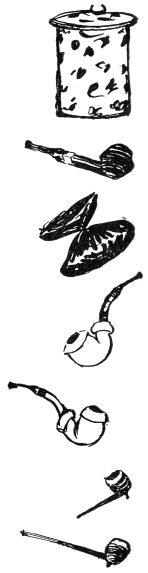

To James Ruskin, Esq., Railway Station Hotel, Willisden.
SIR: — I warn you that I will not accept any more copies of your books. I do not know the individual named Tennyson to whom you refer; but if he is the scribbler who is perpetually sending me copies of his verses, please tell him that I read no poetry except my own. Why can't you leave me alone?
J. MOGGRIDGE, Poet Laureate.
These letters of Jimmy's remind me of our famous competition, which took place on the night of the Jubilee celebrations. When all the rest of London (including William John) was in the streets, the Arcadians met as usual, and Scrymgeour, at my request, put on the shutters to keep out the din. It so happened that Jimmy and Gilray were that night in wicked moods, for Jimmy, who was so anxious to be a journalist, had just had his [pg 221] seventeenth article returned from the St. John's Gazette, and Gilray had been "slated" for his acting of a new part, in all the leading papers. They were now disgracing the tobacco they smoked by quarrelling about whether critics or editors were the more disreputable class, when in walked Pettigrew, who had not visited us for months. Pettigrew is as successful a journalist as Jimmy is unfortunate, and the pallor of his face showed how many Jubilee articles he had written during the past two months. Pettigrew offered each of us a Splendidad (his wife's new brand), which we dropped into the fireplace. Then he filled my little Remus with Arcadia, and sinking weariedly into a chair, said:
"My dear Jimmy, the curse of journalism is not that editors won't accept our articles, but that they want too many from us."
This seemed such monstrous nonsense to Jimmy that he turned his back on Pettigrew, and Gilray broke in with a diatribe against critics.
"Critics," said Pettigrew, "are to be pitied rather than reviled."
Then Gilray and Jimmy had a common foe. Whether it was Pettigrew's appearance among us or the fireworks outside that made us unusually talkative that night I cannot say, but we [pg 222] became quite brilliant, and when Jimmy began to give us his dream about killing an editor, Gilray said that he had a dream about criticising critics; and Pettigrew, not to be outdone, said that he had a dream of what would become of him if he had to write any more Jubilee articles. Then it was that Marriot suggested a competition. "Let each of the grumblers," he said, "describe his dream, and the man whose dream seems the most exhilarating will get from the judges a Jubilee pound-tin of the Arcadia." The grumblers agreed, but each wanted the others to dream first. At last Jimmy began as follows:
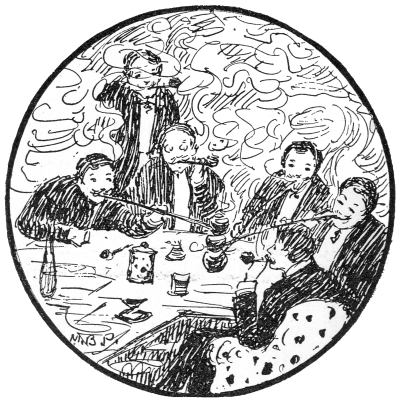
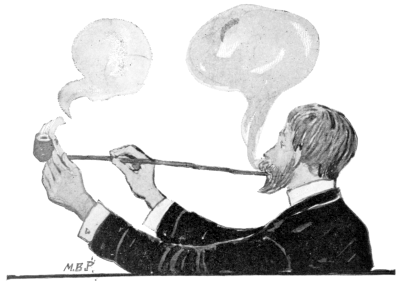
CHAPTER XXVII.
JIMMY'S DREAM.
I see before me (said Jimmy, savagely) a court, where I, James Moggridge, am arraigned on a charge of assaulting the editor of the St. John's Gazette so as to cause death. Little interest is manifested in the case. On being arrested I had pleaded guilty, and up to to-day it had been anticipated that the matter would be settled out of court. No apology, however, being forthcoming, the law has to take its course. The defence is that the assault was [pg 224] fair comment on a matter of public interest, and was warranted in substance and in fact. On making his appearance in the dock the prisoner is received with slight cheering.
Mr. John Jones is the first witness called for the prosecution. He says: I am assistant editor of the St. John's Gazette. It is an evening newspaper of pronounced Radical views. I never saw the prisoner until to-day, but I have frequently communicated with him. It was part of my work to send him back his articles. This often kept me late.
In cross-examination the witness denies that he has ever sent the prisoner other people's articles by mistake. Pressed, he says, he may have done so once. The defendant generally inclosed letters with his articles, in which he called attention to their special features. Sometimes these letters were of a threatening nature, but there was nothing unusual in that.
Cross-examined: The letters were not what he would call alarming. He had not thought of taking any special precautions himself. Of course, in his position, he had to take his chance. So far as he could remember, it was not for his own sake that the prisoner wanted his articles published, but in the interests of the public. He, the prisoner, was vexed, he said, to see the [pg 225] paper full of such inferior matter. Witness had frequently seen letters to the editor from other disinterested contributors couched in similar language. If he was not mistaken, he saw a number of these gentlemen in court. (Applause from the persons referred to.)
Mr. Snodgrass says: I am a poet. I do not compose during the day. The
strain would be too great. Every evening I go out into the streets and
buy the latest editions of the evening journals. If there is anything in
them worthy commemoration in verse, I compose. There is generally
something. I cannot say to which paper I send most of my poems, as I
send to all. One of the weaknesses of the St. John's Gazette is
its poetry. It is not worthy of the name. It is doggerel. I have sought
to improve it, but the editor rejected my contributions. I continued to
send them, hoping that they would educate his taste. One night I had
sent him a very long poem which did not appear in the paper next day. I
was very indignant, and went straight to the office. That was on Jubilee
Day. I was told that the editor had left word that he had just gone into
the country for two days. (Hisses.) I forced my way up the stairs,
however, and when I reached the top I did not know which way to go.
There
[pg 226]
 were a number of doors with "No admittance" printed on them.
(More hissing.) I heard voices in altercation in a room near me. I
thought that was likely to be the editor's. I opened the door and went
in. The prisoner was in the room. He had the editor on the floor and was
jumping on him. I said, "Is that the editor?" He said, "Yes." I said,
"Have you killed him?" He said, "Yes," again. I said, "Oh!" and went
away. That is all I remember of the affair.
were a number of doors with "No admittance" printed on them.
(More hissing.) I heard voices in altercation in a room near me. I
thought that was likely to be the editor's. I opened the door and went
in. The prisoner was in the room. He had the editor on the floor and was
jumping on him. I said, "Is that the editor?" He said, "Yes." I said,
"Have you killed him?" He said, "Yes," again. I said, "Oh!" and went
away. That is all I remember of the affair.
Cross-examined: It did not occur to me to interfere. I thought very little of the affair at the time. I think I mentioned it to my wife in the evening; but I will not swear to that. I am not the Herr Bablerr who compelled his daughter to marry a man she did not love, so that I might write an ode in celebration of the nuptials. I have no daughter. I am a poet.
The foreman printer deposed to having had his attention called to [pg 227] the murder of the editor about three o'clock. He was very busy at the time. About an hour afterward he saw the body and put a placard over it. He spoke of the matter to the assistant editor, who suggested that they had better call in the police. That was done.
A clerk in the counting-house says: I distinctly remember the afternoon of the murder. I can recall it without difficulty, as it was on the following evening that I went to the theatre—a rare occurrence with me. I was running up the stairs when I met a man coming down. I recognized the prisoner as that man. He said, "I have killed your editor." I replied, "Then you ought to be ashamed of yourself." We had no further conversation.
J. O'Leary is next called. He says: I am an Irishman by birth. I had to fly my country when an iniquitous Coercion Act was put in force. At present I am a journalist, and I write Fenian letters for the St. Johns Gazette. I remember the afternoon of the murder. It was the sub-editor who told me of it. He asked me if I would write a "par" on the subject for the fourth edition. I did so; but as I was in a hurry to catch a train it was only a few lines. We did him fuller justice next day.
Cross-examined: Witness denies that he felt [pg 228] any elation on hearing that a new topic had been supplied for writing on. He was sorry rather.
A policeman gives evidence that about half-past four on Jubilee Day he saw a small crowd gather round the entrance to the offices of the St. John's Gazette. He thought it his duty to inquire into the matter. He went inside and asked an office-boy what was up. The boy said he thought the editor had been murdered, but advised him to inquire upstairs. He did so, and the boy's assertion was confirmed. He came down again and told the crowd that it was the editor who had been killed. The crowd then dispersed.
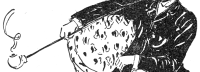
A detective from Scotland Yard explains the method of the prisoner's capture. Moggridge wrote to the superintendent saying that he would be passing Scotland Yard on the following Wednesday on business. Three detectives, including witness, were told off to arrest him, and they succeeded in doing so. (Loud and prolonged applause.)
The judge interposes here. He fails, he says, to see that this evidence is relevant. So far as he can see, the question is not whether a murder has been committed, but whether, under the circumstances, it is a criminal offence. The [pg 229] prisoner should never have been tried here at all. It was a case for the petty sessions. If the counsel cannot give some weighty reason for proceeding with further evidence, he will now put it to the jury.
After a few remarks from the counsel for the prosecution and the counsel for the defence, who calls attention to the prisoner's high and unblemished character, the judge sums up. It is for the jury, he says, to decide whether the prisoner has committed a criminal offence. That was the point; and in deciding it the jury should bear in mind the desirability of suppressing merely vexatious cases. People should not go to law over trifles. Still, the jury must remember that, without exception, all human life was sacred. After some further remarks from the judge, the jury (who deliberate for rather more than three-quarters [pg 230] of an hour) return a verdict of guilty. The prisoner is sentenced to a fine of five florins, or three days' imprisonment.
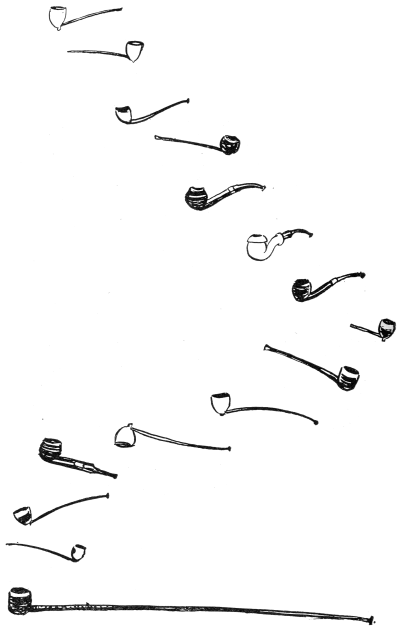
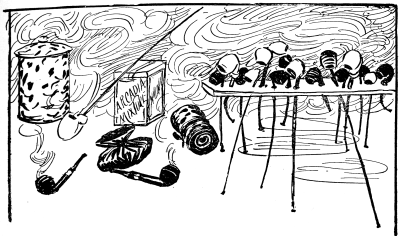
CHAPTER XXVIII.
GILRAY'S DREAM.
Conceive me (said Gilray, with glowing face) invited to write a criticism of the Critics' Dramatic Society for the Standard. I select the Standard, because that paper has treated me most cruelly. However, I loathe them all. My dream is the following criticism:
What is the Critics' Dramatic Society? We found out on Wednesday afternoon, and, as we went to Drury Lane in the interests of the public, it is only fair that the public should know too. Besides, in that case we can all bear it together. Be it known, then, that this Dramatic Society is composed of "critics" who gave "The School for Scandal" at a matinée on [pg 232] Wednesday just to show how the piece should be played. Mr. Augustus Harris had "kindly put the theatre at their disposal," for which he will have to answer when he joins Sheridan in the Elysian Fields. As the performance was by far the worst ever perpetrated, it would be a shame to deprive the twentieth century of the programme. Some of the players, as will be seen, are too well known to escape obloquy. The others may yet be able to sink into oblivion.
| Sir Peter Teazle | Mr. John Ruskin. |
| Joseph Surface | Mr. W. E. Henley. |
| Charles Surface | Mr. Harry Labouchere. |
| Crabtree | Mr. W. Archer. |
| Sir Benjamin Backbite | Mr. Clement Scott. |
| Moses | Mr. Walter Sichel. |
| Old Rowley | Mr. Joseph Knight. |
| Sir Oliver | Mr. W. H. Pollock. |
| Trip | Mr. G. A. Sala. |
| Snake | Mr. Moy Thomas. |
| Sir Harry Bumper (with song) | Mr. George Moore. |
| Servants, Guests, etc. | Messrs. Saville Clarke, Joseph Hatton, Percy Fitzgerald, etc. |
| Assisted by | |
| Lady Teazle | Miss Rosie Le Dene. |
| Mrs. Candour | Miss Jenny Montalban. |
| Lady Sneerwell | Miss Rosalind Labelle (The Hon. Mrs. Major Turnley). |
| Maria | Miss Jones. |
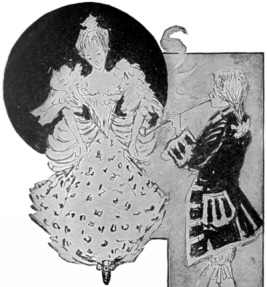
It was a sin of omission on the part of the Critics' Dramatic Society not to state that the [pg 233] piece played was "a new and original comedy" in many acts. Had they had the courage to do this, and to change the title, no one would even have known. On the other hand, it was a sin of commission to allow that Professor Henry Morley was responsible for the stage management; Mr. Morley being a man of letters whom some worthy people respect. But perhaps sins of omission and commission counterbalance. The audience was put in a bad humor before the performance began, owing to the curtain's rising fifteen minutes late. However, once the curtain did rise, it was an unconscionable time in falling. What is known as the "business" of the first act, including the caterwauling of Sir Benjamin Backbite and Crabtree in their revolutions round Joseph, was gone through with a deliberation that was cruelty to the audience, and just when the act seemed over at last these indefatigable amateurs began to dance a minuet. A sigh ran round the theatre at this—a sigh as full of suffering as when a minister, having finished his thirdly and lastly, starts off again, with, "I cannot allow this opportunity to pass." Possibly the Critics' Dramatic Society are congratulating themselves on the undeniable fact that the sighs and hisses grew beautifully less as the performance proceeded. But that was because [pg 234] the audience diminished too. One man cannot be expected to sigh like twenty; though, indeed, some of the audience of Wednesday sighed like at least half a dozen.
If it be true that all men—even critics—have their redeeming points and failings, then was there no Charles and no Joseph Surface at this unique matinée. For the ungainly gentleman who essayed the part of Charles made, or rather meant to make, him spotless; and Mr. Henley's Joseph was twin-brother to Mr. Irving's Mephistopheles. Perhaps the idea of Mr. Labouchere and his friend, Mr. Henley, was that they would make one young man between them. They found it hard work. Mr. Labouchere has yet to learn that buffoonery is not exactly wit, and that Charles Surfaces who dig their uncle Olivers in the ribs, and then turn to the audience for applause, are among the things that the nineteenth century can do without. According to the programme, Mr. George Moore—the Sir Harry Bumper—was to sing the song, "Here's to the Maiden of Bashful Fifteen." Mr. Moore did not sing it, but Mr. Labouchere did. The explanation of this, we understand, was not that Sir Harry's heart failed him at the eleventh hour, but that Mr. Labouchere threatened to fling up his part [pg 235] unless the song was given to him. However, Mr. Moore heard Mr. Labouchere singing the song, and that was revenge enough for any man. To Mr. Henley the part of Joseph evidently presented no serious difficulties. In his opinion, Joseph is a [pg 236] whining hypocrite who rolls his eyes when he wishes to look natural. Obviously he is a slavish admirer of Mr. Irving. If Joseph had taken his snuff as this one does, Lady Sneerwell would have sent him to the kitchen. If he had made love to Lady Teazle as this one does, she would have suspected him of weak intellect. Sheridan's Joseph was a man of culture: Mr. Henley's is a buffoon. It is not, perhaps, so much this gentleman's fault as his misfortune that his acting is without either art or craft; but then he was not compelled to play Joseph Surface. Indeed, we may go further, and say that if he is a man with friends he must have been dissuaded from it. The Sir Peter Teazle of Mr. Ruskin reminded us of other Sir Peter Teazles—probably because Sir Peter is played nowadays with his courtliness omitted.
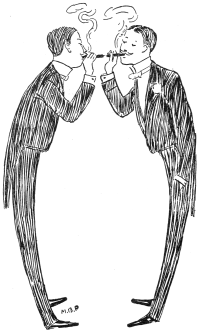
Mr. William Archer was the Crabtree, or rather Mr. Archer and the prompter between them. Until we caught sight of the prompter we had credited Mr. Archer with being a ventriloquist given to casting his voice to the wings. Mr. Clement Scott—their Benjamin Backbite—was a ventriloquist too, but not in such a large way as Mr. Archer. His voice, so far as we could make out from an occasional rumble, [pg 237] was in his boots, where his courage kept it company. There was no more ambitious actor in the cast than Mr. Pollock. Mr. Pollock was Sir Oliver, and he gave a highly original reading of that old gentleman. What Mr. Pollock's private opinion of the character of Sir Oliver may be we cannot say; it would be worth an interviewer's while to find out. But if he thinks Sir Oliver was a windmill, we can inform him at once that he is mistaken. Of Mr. Sichel's Moses all that occurs to us to say is that when he let his left arm hang down and raised the other aloft, he looked very like a tea-pot. Mr. Joseph Knight was Old Rowley. In that character all we saw of him was his back; and we [pg 238] are bound to admit that it was unexceptional. Sheridan calls one of his servants Snake, and the other Trip. Mr. Moy Thomas tried to look as like a snake as he could, and with some success. The Trip of Mr. Sala, however, was a little heavy, and when he came between the audience and the other actors there was a temporary eclipse. As for the minor parts, the gentlemen who personated them gave a capital rendering of supers suffering from stage-fever. Wednesday is memorable in the history of the stage, but we would forget it if we could.
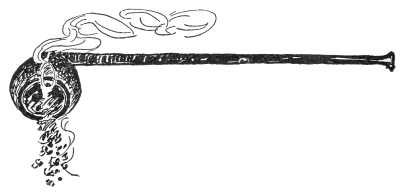
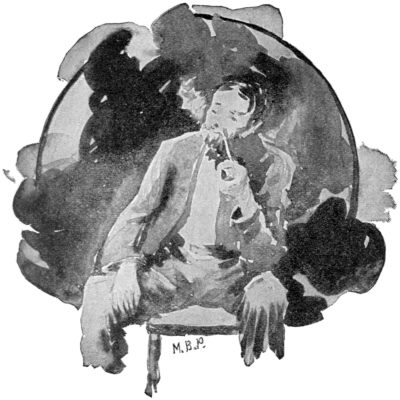
CHAPTER XXIX.
PETTIGREW'S DREAM.
My dream (said Pettigrew) contrasts sadly with those of my young friends. They dream of revenge, but my dream is tragic. I see my editor writing my obituary notice. This is how it reads:

Mr. Pettigrew, M.A., whose sad death is recorded in another column, was in his forty-second [pg 240] year (not his forty-fourth, as stated in the evening papers), and had done a good deal of Jubilee work before he accepted the commission that led to his death. It is an open secret that he wrote seventy of the Jubilee sketches which have appeared in this paper. The pamphlet now selling in the streets for a penny, entitled "Jubilees of the Past," was his. He wrote the introductory chapter to "Fifty Years of Progress," and his "Jubilee Statesmen" is now in a second edition. The idea of a collection of Jubilee odes was not his, but the publisher's. At the same time, his friends and relatives attach no blame to them. Mr. Pettigrew shivered when the order was given to him, but he accepted it, and the general impression among those who knew him was that a man who had survived "Jubilee Statesmen" could do anything. As it turns out, we had overestimated Mr. Pettigrew's powers of endurance.
As "The Jubilee Odes" will doubtless yet be collected by another hand,
little need be said here of the work. Mr. Pettigrew was to make his
collection as complete as the limited space at his disposal (two
volumes) would allow; the only original writing in the book being a
sketch of the various schemes suggested for the celebration of the
Jubilee. It was this sketch that
[pg 241]
killed him. On the morning of the 27th,
when he intended beginning it, he rose at an unusually early hour,
and was seen from the windows of the house pacing the garden in an
apparently agitated state of mind. He ate no breakfast. One of his
daughters states that she noticed a wild look in his eyes during the
morning meal; but, as she did not remark on it at the time, much stress
need not be laid on this. The others say that he was unusually quiet and
silent. All, however, noticed one thing. Generally, when he had literary
work to do, he was anxious to begin upon his labors, and spent little
time at the breakfast-table. On this occasion he sat on. Even after the
breakfast things were removed he seemed reluctant to adjourn to the
study. His wife asked him several times if he meant to begin "The
Jubilee Odes" that day, and he always replied in the affirmative. But
he talked nervously of other things; and, to her surprise—though she
thought comparatively little of it
[pg 242]
at the time—drew her on to a
discussion on summer bonnets. As a rule, this was a subject which he
shunned. At last he rose, and, going slowly to the window, looked out
for a quarter of an hour. His wife asked him again about "The Jubilee
Odes," and he replied that he meant to begin directly. Then he went
round the morning-room, looking at the pictures on the walls as if for
the first time. After that he leaned for a little while against the
mantelpiece, and then, as if an idea had struck him, began to wind up
the clock. He went through the house winding up the clocks, though this
duty was usually left to a servant; and when that was over he came back
to the breakfast-room and talked about Waterbury watches. His wife had
to go to the kitchen, and he followed her. On their way back they passed
the nursery, and he said he thought he would go in and talk to the
nurse. This was very unlike him. At last his wife said that it would
soon be luncheon-time, and then he went to the study. Some ten minutes
afterward he wandered into the dining-room, where she was arranging some
flowers. He seemed taken aback at seeing her, but said, after a moment's
thought, that the study door was locked and he could not find the key.
This astonished her, as she had dusted
[pg 243]
the room herself that morning.
She went to see, and found the study door standing open. When she
returned to the dining-room he had disappeared. They searched for him
everywhere, and eventually discovered him in the drawing-room, turning
over a photograph album. He then went back to the study. His wife
accompanied
 him, and, as was her custom, filled his pipe for him. He
smoked a mixture to which he was passionately attached. He lighted his
pipe several times, but it always went out. His wife put a new nib into
his pen, placed some writing material on the table, and then retired,
shutting the door behind her.
him, and, as was her custom, filled his pipe for him. He
smoked a mixture to which he was passionately attached. He lighted his
pipe several times, but it always went out. His wife put a new nib into
his pen, placed some writing material on the table, and then retired,
shutting the door behind her.
About half an hour afterward Mrs. Pettigrew sent one of the children to
the study on a trifling errand. As he did not return she followed him.
She found him sitting on his father's knee, where she did not remember
ever having seen him before. Mr. Pettigrew was holding his watch to
the boy's ears. The study table was littered with several hundreds of
Jubilee odes. Other odes had slipped to the floor. Mrs. Pettigrew asked
how he was getting on, and her unhappy
[pg 244]
husband replied that he was just
going to begin. His hands were trembling, and he had given up trying to
smoke. He sought to detain her by talking about the boy's curls; but she
went away, taking the child with her. As she closed the door he groaned
heavily, and she reopened it to ask if he felt unwell. He answered in
the negative, and she left him. The last
 person to see Mr. Pettigrew
alive was Eliza Day, the housemaid. She took a letter to him between
twelve and one o'clock. Usually he disliked being disturbed at his
writing; but this time, in answer to her knock, he cried eagerly, "Come
in!" When she entered he insisted on her taking a chair, and asked her
how all her people were, and if there was anything he could do for them.
Several times she rose to leave, but he would not allow her to do so.
Eliza mentioned this in the kitchen when she returned to it. Her master
was naturally a reserved man who seldom spoke to his servants, which
rendered his behavior on this occasion the more remarkable.
person to see Mr. Pettigrew
alive was Eliza Day, the housemaid. She took a letter to him between
twelve and one o'clock. Usually he disliked being disturbed at his
writing; but this time, in answer to her knock, he cried eagerly, "Come
in!" When she entered he insisted on her taking a chair, and asked her
how all her people were, and if there was anything he could do for them.
Several times she rose to leave, but he would not allow her to do so.
Eliza mentioned this in the kitchen when she returned to it. Her master
was naturally a reserved man who seldom spoke to his servants, which
rendered his behavior on this occasion the more remarkable.
As announced in the evening papers yesterday, the servant sent to the study at half-past one to see why Mr. Pettigrew was not coming to [pg 245] lunch, found him lifeless on the floor. The knife clutched in his hand showed that he had done the fatal deed himself; and Dr. Southwick, of Hyde Park, who was on the spot within ten minutes of the painful discovery, is of opinion that life had been extinct for about half an hour. The body was lying among Jubilee odes. On the table were a dozen or more sheets of "copy," which, though only spoiled pages, showed that the deceased had not succumbed without a struggle. On one he had begun, "Fifty years have come and gone since a fair English maiden ascended the throne of England." Another stopped short at, "To every loyal Englishman the Jubil——" A third sheet commenced with, "Though there have been a number of royal Jubilees in the history of the world, probably none has awakened the same interest as ——" and a fourth began, "1887 will be known to all future ages as the year of Jub——" One sheet bore the sentence, "Heaven help me!" and it is believed that these were the last words the deceased ever penned.
Mr. Pettigrew was a most estimable man in private life, and will be greatly missed in the circles to which he had endeared himself. He leaves a widow and a small family. It may be [pg 246] worth adding that when discovered dead, there was a smile upon his face, as if he had at last found peace. He must have suffered great agony that forenoon, and his death is best looked upon as a happy release.
Marriot, Scrymgeour and I awarded the tin of Arcadia to Pettigrew, because he alone of the competitors seemed to believe that his dream might be realized.
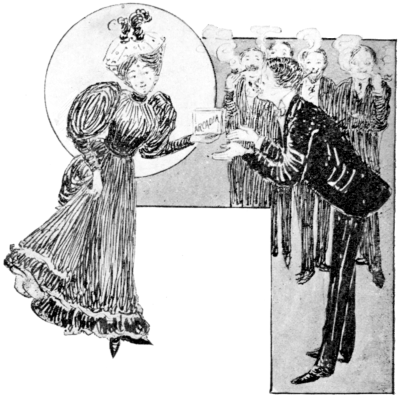
CHAPTER XXX.
THE MURDER IN THE INN.
Sometimes I think it is all a dream, and that I did not really murder the waits. Perhaps they are living still. Yet the scene is very vivid before me, though the affair took place—if it ever did take place—so long ago that I cannot be expected to remember the details. The time when I must give up smoking was drawing near, so that I may have been unusually irritable, and determined, whatever the cost, to smoke my last pound-tin of the Arcadia in peace. I think my brier was in my mouth when I did it, but after the lapse of months I cannot say whether there were three of them or [pg 248] only two. So far as I can remember, I took the man with the beard first.
The incident would have made more impression on me had there been any talk about it. So far as I could discover, it never got into the papers. The porters did not seem to think it any affair of theirs, though one of them must have guessed why I invited the waits upstairs. He saw me open the door to them; he was aware that this was their third visit in a week; and only the night before he had heard me shout a warning to them from my inn window. But of course the porters must allow themselves a certain discretion in the performance of their duties. Then there was the pleasant gentleman of the next door but two, who ran against me just as I was toppling the second body over the railing. We were not acquainted, but I knew him as the man who had flung a water-jug at the waits the night before. He stopped short when he saw the body (it had rolled out of the sofa-rug), and looked at me suspiciously. "He is one of the waits," I said. "I beg your pardon," he replied, "I did not understand." When he had passed a few yards he turned round. "Better cover him up," he said; "our people will talk." Then he strolled away, an air from "The Grand Duchess" lightly trolling [pg 249] from his lips. We still meet occasionally, and nod if no one is looking.
I am going too fast, however. What I meant to say was that the murder was premeditated. In the case of a reprehensible murder I know this would be considered an aggravation of the offence. Of course, it is an open question whether all the murders are not reprehensible; but let that pass. To my own mind I should have been indeed deserving of punishment had I rushed out and slain the waits in a moment of fury. If one were to give way to his passion every time he is interrupted in his work or his sleep by bawlers our thoroughfares would soon be choked with the dead. No one values human life or understands its sacredness more than I do. I merely say that there may be times when a man, having stood a great deal and thought it over calmly, is justified in taking the law into his own hands—always supposing he can do it decently, quietly, and without scandal. The epidemic of waits broke out early in December, and every other night or so these torments came in the still hours and burst into song beneath my windows. They made me nervous. I was more wretched on the nights they did not come than on the nights they came; for I had begun to listen for them, and was never sure [pg 250] they had gone into another locality before four o'clock in the morning. As for their songs, they were more like music-hall ditties than Christmas carols. So one morning—it was, I think, the 23d of December—I warned them fairly, fully, and with particulars, of what would happen if they disturbed me again. Having given them this warning, can it be said that I was to blame—at least, to any considerable extent?
Christmas eve had worn into Christmas morning before the waits arrived on that fateful occasion. I opened the window—if my memory does not deceive me—at once, and looked down at them. I could not swear to their being the persons whom I had warned the night before. Perhaps I should have made sure of this. But in any case these were practised waits. Their whine rushed in at my open window with a vigor that proved them no tyros. Besides, the night was a cold one, and I could not linger at an open casement. I nodded pleasantly to the waits and pointed to my door. Then I ran downstairs and let them in. They came up to my chambers with me. As I have said, the lapse of time prevents my remembering how many of them there were; three, I fancy. At all events, I took them into my bedroom and [pg 251] strangled them one by one. They went off quite peaceably; the only difficulty was in the disposal of the bodies. I thought of laying them on the curb-stone in different passages; but I was afraid the police might not see that they were waits, in which case I might be put to inconvenience. So I took a spade and dug two (or three) large holes in the quadrangle of the inn. Then I carried the bodies to the place in my rug, one at a time, shoved them in, and covered them up. A close observer might have noticed in that part of the quadrangle, for some time after, a small mound, such as might be made by an elbow under the bed-clothes. Nobody, however, seems to have descried it, and yet I see it often even now in my dreams.
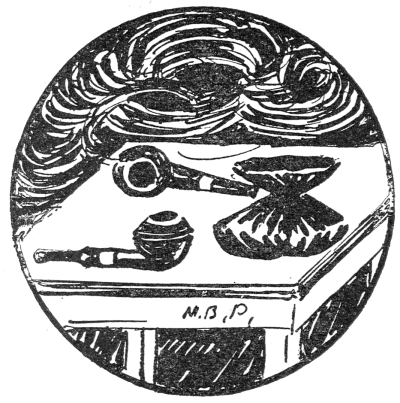
CHAPTER XXXI.
THE PERILS OF NOT SMOKING.

When the Arcadians heard that I had signed an agreement to give up smoking they were first incredulous, then sarcastic, then angry. Instead of coming, as usual, to my room, they went one night in a body to Pettigrew's, and there, as I afterward discovered, a scheme for "saving me" was drawn up. So little did they understand the firmness of my character, that they thought I had weakly yielded to the threats of the lady referred to in my first chapter, when, of course, I had only yielded to her arguments, and they agreed to make an appeal on my behalf to her. Pettigrew, as a married man himself, was appointed intercessor, and I understand that the others not only accompanied [pg 253] him to her door, but waited in an alley until he came out. I never knew whether the reasoning brought to bear on the lady was of Pettigrew's devising, or suggested by Jimmy and the others, but it was certainly unselfish of Pettigrew to lie so freely on my account. At the time, however, the plot enraged me, for the lady conceived the absurd idea that I had sent Pettigrew to her. Undoubtedly it was a bold stroke. Pettigrew's scheme was to play upon his hostess's attachment for me by hinting to her that if I gave up smoking I would probably die. Finding her attentive rather than talkative, he soon dared to assure her that he himself loathed tobacco and only took it for his health.
"By the doctor's orders, mark you," he said, impressively; "Dr. Southwick, of Hyde Park."
She expressed polite surprise at this, and then Pettigrew, believing he had made an impression, told his story as concocted.
"My own case," he said, "is one much in point. I suffered lately from sore throat, accompanied by depression of spirits and loss of appetite. The ailment was so unusual with me that I thought it prudent to put myself in Dr. Southwick's hands. As far as possible I shall give you his exact words:
"'When did you give up smoking?' he asked, abruptly, after examining my throat.
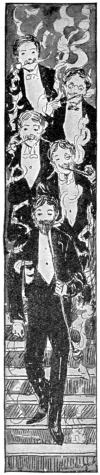
"'Three months ago,' I replied, taken by surprise; 'but how did you know I had given it up?'
"'Never mind how I know,' he said, severely; 'I told you that, however much you might desire to do so, you were not to take to not smoking. This is how you carry out my directions.'
"'Well,' I answered sulkily, 'I have been feeling so healthy for the last two years that I thought I could indulge myself a little. You are aware how I abominate tobacco.'
"'Quite so,' he said, 'and now you see the result of this miserable self-indulgence. Two years ago I prescribed tobacco for you, to be taken three times a day, and you yourself admit that it made a new man of you. Instead of feeling thankful you complain of the brief unpleasantness [pg 255] that accompanies its consumption, and now, in the teeth of my instructions, you give it up. I must say the ways of patients are a constant marvel to me.'
"'But how,' I asked, 'do you know that my reverting to the pleasant habit of not smoking is the cause of my present ailment?'
"'Oh!' he said, 'you are not sure of that yourself, are you?'
"'I thought,' I replied, 'there might be a doubt about it; though of course I have forgotten what you told me two years ago.'
"'It matters very little,' he said, 'whether you remember what I tell you if you do not follow my orders. But as for knowing that indulgence in not smoking is what has brought you to this state, how long is it since you noticed these symptoms?'
"'I can hardly say,' I answered. 'Still, I should be able to think back. I had my first sore throat this year the night I saw Mr. Irving at the Lyceum, and that was on my wife's birthday, the 3d of October. How long ago is that?'
"'Why, that is more than three months ago. Are you sure of the date?'"
"'Quite certain,' I told him; 'so, you see, I had my first sore throat before I risked not smoking again.'"
"'I don't understand this,' he said. 'Do you mean to say that in the beginning of May you were taking my prescription daily? You were not missing a day now and then—forgetting to order a new stock of cigars when the others were done, or flinging them away before they were half smoked? Patients do such things.'
"'No, I assure you I compelled myself to smoke. At least——'
"'At least what? Come, now, if I am to be of any service to you, there must be no reserve.'
"'Well, now that I think of it, I was only smoking one cigar a day at that time.'
"'Ah! we have it now,' he cried. 'One cigar a day, when I ordered you three? I might have guessed as much. When I tell non-smokers that they must smoke or I will not be answerable for the consequences, they entreat me to let them break themselves of the habit of not smoking gradually. One cigarette a day to begin with, they beg of me, promising to increase the dose by degrees. Why, man, one cigarette a day is poison; it is worse than not smoking.'
"'But that is not what I did.'
"'The idea is the same,' he said. 'Like the others, you make all this moan about giving up completely a habit you should never have acquired. [pg 257] For my own part, I cannot even understand where the subtle delights of not smoking come in. Compared with health, they are surely immaterial.'
"'Of course, I admit that.'
"'Then, if you admit it, why pamper yourself?'
"'I suppose because one is weak in matters of habit. You have many cases like mine?'
"'I have such cases every week,' he told me; 'indeed, it was having so many cases of the kind that made me a specialist in the subject. When I began practice I had not the least notion how common the non-tobacco throat, as I call it, is.'
"'But the disease has been known, has it not, for a long time?'
"'Yes,' he said;' but the cause has only been discovered recently. I could explain the malady to you scientifically, as many medical men would prefer to do, but you are better to have it in plain English.'
"'Certainly; but I should like to know whether the symptoms in other cases have been in every way similar to mine.'
"'They have doubtless differed in degree, but not otherwise,' he answered. 'For instance, you say your sore throat is accompanied by depression of spirits.'
"'Yes; indeed, the depression sometimes precedes the sore throat.'
"'Exactly. I presume, too, that you feel most depressed in the evening—say, immediately after dinner?'
"'That is certainly the time I experience the depression most.'
"'The result,' he said, 'if I may venture on somewhat delicate matters, is that your depression of spirits infects your wife and family, even your servants?'
"'That is quite true,' I answered. 'Our home has by no means been so happy as formerly. When a man is out of spirits, I suppose, he tends to be brusque and undemonstrative to his wife, and to be easily irritated by his children. Certainly that has been the case with me of late.'
"'Yes,' he exclaimed, 'and all because you have not carried out my directions. Men ought to see that they have no right to indulge in not smoking, if only for the sake of their wives and families. A bachelor has more excuse, perhaps; but think of the example you set your children in not making an effort to shake this self-indulgence off. In short, smoke for the sake of your wife and family, if you won't smoke for the sake of your health.'"
I think this is pretty nearly the whole of Pettigrew's story, but I may add that he left the house in depression of spirits, and then infected Jimmy and the others with the same ailment, so that they should all have hurried in a cab to the house of Dr. Southwick.
"Honestly," Pettigrew said, "I don't think she believed a word I told her."
"If she had only been a man," Marriot sighed, "we could have got round her."
"How?" asked Pettigrew.
"Why, of course," said Marriot, "we could have sent her a tin of the Arcadia."
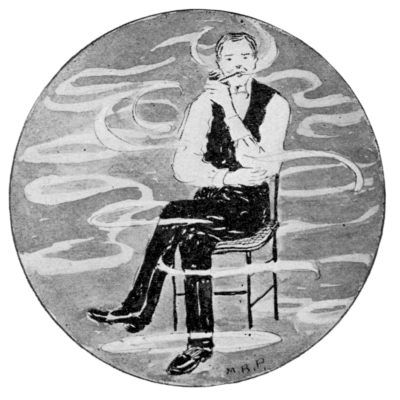
CHAPTER XXXII.
MY LAST PIPE.

The night of my last smoke drew near without any demonstration on my part or on that of my friends. I noticed that none of them was now comfortable if left alone with me, and I knew, I cannot tell how, that though they had too much delicacy to refer in my presence to my coming happiness, they often talked of it among themselves. They smoked hard and looked covertly at me, and had an idea that they were helping me. They also addressed me in a low voice, and took their seats noiselessly, as if some one were ill in the next room.
"We have a notion," Scrymgeour said, with an effort, on my second night, "that you would rather we did not feast you to-morrow evening?"
"Oh, I want nothing of that kind," I said.
"So I fancied," Jimmy broke in. "Those things are rather a mockery, but of course if you thought it would help you in any way——"
"Or if there is anything else we could do for you," interposed Gilray, "you have only to mention it."
Though they irritated rather than soothed me, I was touched by their kindly intentions, for at one time I feared my friends would be sarcastic. The next night was my last, and I found that they had been looking forward to it with genuine pain. As will have been seen, their custom was to wander into my room one by one, but this time they came together. They had met in the boudoir, and came up the stair so quietly that I did not hear them. They all looked very subdued, and Marriot took the cane chair so softly that it did not creak. I noticed that after a furtive glance at me each of them looked at the centre-table, on which lay my brier, Romulus and Remus, three other pipes that all had their merits, though they never touched my heart until now, my clay tobacco-jar, and my old pouch. I had said good-by to these before my friends came in, and I could now speak with a comparatively firm voice. Marriot and Gilray and Scrymgeour signed to Jimmy, as if some plan of action had been arranged, [pg 262] and Jimmy said huskily, sitting upon the hearth-rug:
"Pettigrew isn't coming. He was afraid he would break down."
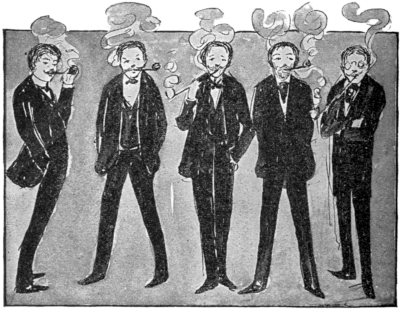
Then we began to smoke. It was as yet too early in the night for my last pipe, but soon I regretted that I had not arranged to spend this night alone. Jimmy was the only one of the Arcadians who had been at school with me, and he was full of reminiscences which he addressed to the others just as if I were not present.
"He was the life of the old school," Jimmy said, referring to me, "and when I shut my eyes [pg 263] I can hear his merry laugh as if we were both in knickerbockers still."
"What sort of character did he have among the fellows?" Gilray whispered.
"The very best. He was the soul of honor, and we all anticipated a great future for him. Even the masters loved him; indeed, I question if he had an enemy."
"I remember my first meeting with him at the university," said Marriot, "and that I took to him at once. He was speaking at the debating society that night, and his enthusiasm quite carried me away."
"And how we shall miss him here," said Scrymgeour, "and in my house-boat! I think I had better sell the house-boat. Do you remember his favorite seat at the door of the saloon?"
"Do you know," said Marriot, looking a little scared, "I thought I would be the first of our lot to go. Often I have kept him up late in this very room talking of my own troubles, and little guessing why he sometimes treated them a little testily."
So they talked, meaning very well, and by and by it struck one o'clock. A cold shiver passed through me, and Marriot jumped from his chair. It had been agreed that I should begin my last pipe at one precisely.
Whatever my feelings were up to this point I had kept them out of my face, but I suppose a change came over me now. I tried to lift my brier from the table, but my hand shook and the pipe tapped, tapped on the deal like an auctioneer's hammer.
"Let me fill it," Jimmy said, and he took my old brier from me. He scraped it energetically so that it might hold as much as possible, and then he filled it. Not one of them, I am glad to remember, proposed a cigar for my last smoke, or thought it possible that I would say farewell to tobacco through the medium of any other pipe than my brier. I liked my brier best. I have said this already, but I must say it again. Jimmy handed the brier to Gilray, who did not surrender it until it reached my mouth. Then Scrymgeour made a spill, and Marriot lighted it. In another moment I was smoking my last pipe. The others glanced at one another, hesitated, and put their pipes into their pockets.
There was little talking, for they all gazed at me as if something astounding might happen at any moment. The clock had stopped, but the ventilator was clicking. Although Jimmy and the others saw only me, I tried not to see only them. I conjured up the face of a lady, and she smiled encouragingly, and then I felt safer. [pg 265] But at times her face was lost in smoke, or suddenly it was Marriot's face, eager, doleful, wistful.
At first I puffed vigorously and wastefully,
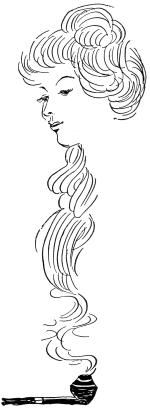 then I became scientific
and sent out rings of smoke so strong and numerous that half a dozen
of them were in the air at a time. In past days I had often followed
a ring over the table, across chairs, and nearly out at the window, but
that was when I blew one by accident and was loath to let it go. Now
I distributed them among my friends, who let them slip away into the
looking-glass. I think I had almost forgotten what I was doing and where
I was when an awful thing happened. My pipe went out!
then I became scientific
and sent out rings of smoke so strong and numerous that half a dozen
of them were in the air at a time. In past days I had often followed
a ring over the table, across chairs, and nearly out at the window, but
that was when I blew one by accident and was loath to let it go. Now
I distributed them among my friends, who let them slip away into the
looking-glass. I think I had almost forgotten what I was doing and where
I was when an awful thing happened. My pipe went out!
"There are remnants in it yet," Jimmy cried, with forced cheerfulness, while Gilray blew the ashes off my sleeve, Marriot slipped a cushion behind my back, and Scrymgeour made another spill. Again I smoked, but no longer recklessly.
It is revealing no secret to say that a drowning man sees his whole past unfurl before him like a panorama. So little, however, was I, now on the eve of a great happiness, like a drowning man, that nothing whatever passed before me. I lost sight even of my friends, and though Jimmy was on his knees at my feet, his hand clasping mine, he disappeared as if his open mouth had swallowed the rest of his face. I had only one thought—that I was smoking my last pipe. Unconsciously I crossed my legs, and one of my slippers fell off; Jimmy, I think, slipped it on to my foot. Marriot stood over me, gazing into the bowl of my pipe, but I did not see him.
Now I was puffing tremendously, but no smoke came. The room returned to me, I saw Jimmy clearly, I felt Marriot overhead, and I heard them all whispering. Still I puffed; I knew that my pipe was empty, but still I puffed. Gilray's fingers tried to draw my brier from my mouth, but I bit into it with my teeth, and still I puffed.
When I came to I was alone. I had a dim consciousness of having been shaken by several hands, of a voice that I think was Scrymgeour's saying that he would often write to me—though my new home was to be within the four-mile [pg 267] radius—and of another voice that I think was Jimmy's, telling Marriot not to let me see him breaking down. But though I had ceased to puff, my brier was still in my mouth; and, indeed, I found it there when William John shook me into life next morning.
My parting with William John was almost sadder than the scene of the previous night. I rang for him when I had tied up all my treasures in brown paper, and I told him to give the tobacco-jar to Jimmy, Romulus to Marriot, Remus to Gilray, and the pouch to Scrymgeour. William John bore up till I came to the pouch, when he fairly blubbered. I had to hurry into my bedroom, but I mean to do something yet for William John. Not even Scrymgeour knew so well as he what my pouch had [pg 268] been to me, and till I die I shall always regret that I did not give it to William John. I kept my brier.
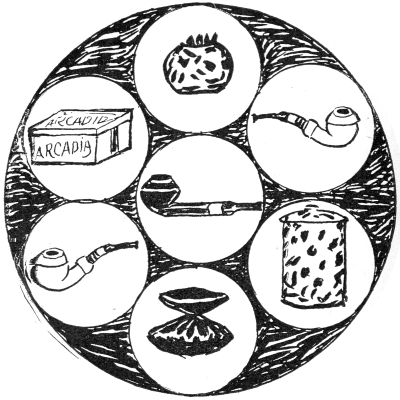
CHAPTER XXXIII.
WHEN MY WIFE IS ASLEEP AND ALL THE HOUSE IS STILL.
Perhaps the heading of this paper will deceive some readers into thinking that I smoke nowadays in camera. It is, I know, a common jest among smokers that such a promise as mine is seldom kept, and I allow that the Arcadians tempt me still. But never shall it be said of me with truth that I have broken my word. I smoke no more, and, indeed, though the scenes of my bachelorhood frequently rise before me in dreams, painted as Scrymgeour could not paint them, I am glad, when I wake up, that they are only dreams. Those selfish days are done, and I see that though they were happy days, the happiness was a mistake. As for the struggle that is supposed to take place between a man and tobacco, after he sees smoking in its true colors, I never experienced it. I have not even [pg 270] any craving for the Arcadia now, though it is a tobacco that should only be smoked by our greatest men. Were we to present a tin of it to our national heroes, instead of the freedom of the city, they would probably thank us more. Jimmy and the others are quite unworthy to smoke it; indeed, if I had my way they would give up smoking altogether. Nothing, perhaps, shows more completely how I have severed my bonds than this: that my wife is willing to let our friends smoke in the study, but I will not hear of it. There shall be no smoking in my house; and I have determined to speak to Jimmy about smoking out at our spare bedroom window. It is a mere contemptible pretence to say that none of the smoke comes back into the room. The curtains positively reek of it, and we must have them washed at once. I shall speak plainly to Jimmy because I want him to tell the others. They must understand clearly on what terms they are received in this house, and if they prefer making chimneys of themselves to listening to music, by all means let them stay at home.
But when my wife is asleep and all the house is still, I listen to the man through the wall. At such times I have my brier in my mouth, but there is no harm in that, for it is empty. I [pg 271] did not like to give away my brier, knowing no one who understood it, and I always carry it about with me now to remind me of my dark past. When the man through the wall lights up I put my cold pipe in my mouth and we have a quiet hour together.
I have never, to my knowledge, seen the man through the wall, for his
door is round the corner, and, besides, I have no interest in him until
half-past eleven P.M. We begin then. I know him chiefly by his pipes,
and them I know by his taps on the wall as he knocks the ashes out of
them. He does not smoke the Arcadia, for his temper is hasty, and he
breaks the coals with his foot. Though I am compelled to say that I do
not consider his character very lovable, he has his good points, and I
like his attachment to his brier. He scrapes it, on the whole, a little
roughly, but that is because he is so anxious to light up again, and I
discovered long ago that he has signed an agreement with his wife to go
to bed at half-past twelve. For some time I could not understand why
he had a silver rim put on the bowl. I noticed the change in the tap
at once, and the natural conclusion would have been that the bowl had
cracked. But it never had the tap of a cracked bowl. I was reluctant
to believe that the man through the
[pg 272]
wall was merely some vulgar fellow,
and I felt that he could not be so, or else he would have smoked his
meerschaum more. At last I understood. The bowl had worn away on one
side,
 and the silver rim had been needed to keep the tobacco in.
Undoubtedly this was the explanation, for even before the rim came I was
a little puzzled by the taps of the brier. He never seemed to hit the
wall with the whole mouth of the bowl, but of course the reason was that
he could not. At the same time I do not exonerate him from blame. He is
a clumsy smoker to burn his bowl at one side, and I am afraid he lets
the stem slip round in his teeth. Of course, I see that the mouth-piece
is loose, but a piece of blotting-paper would remedy that.
and the silver rim had been needed to keep the tobacco in.
Undoubtedly this was the explanation, for even before the rim came I was
a little puzzled by the taps of the brier. He never seemed to hit the
wall with the whole mouth of the bowl, but of course the reason was that
he could not. At the same time I do not exonerate him from blame. He is
a clumsy smoker to burn his bowl at one side, and I am afraid he lets
the stem slip round in his teeth. Of course, I see that the mouth-piece
is loose, but a piece of blotting-paper would remedy that.
His meerschaum is not such a good one as Jimmy's. Though Jimmy's boastfulness about his meerschaum was hard to bear, none of us ever denied the pipe's worth. The man through the wall has not a cherry-wood stem to his meerschaum, and consequently it is too light. A ring has been worn into the palm of his left hand, owing to his tapping the meerschaum there, and it is as marked as Jimmy's ring, for, though Jimmy tapped more strongly, the man through the wall has to tap oftener.
What I chiefly dislike about the man through the wall is his treatment of his clay. A clay, I need scarcely say, has an entirely different tap from a meerschaum, but the man through the wall does not treat these two pipes as if they were on an equality. He ought to tap his clay on the palm of his hand, but he seldom does so, and I am strongly of opinion that when he does, it is only because he has forgotten that this is not the meerschaum. Were he to tap the clay on the walls or on the ribs of the fireplace he would smash it, so he taps it on a coal. About this there is something contemptible. I am not complaining because he has little affection for his clay. In face of all that has been said in honor of clays, and knowing that this statement will occasion an outcry against me, I [pg 274] admit that I never cared for clays myself. A rank tobacco is less rank through a church-warden, but to smoke the Arcadia through a clay is to incur my contempt, and even my resentment. But to disbelieve in clays is one thing and to treat them badly is another. If the man through the wall has decided, after reflection and experiment, that his clay is a mistake, I say let him smoke it no more; but so long as he does smoke it I would have it receive consideration from him. I very much question whether, if he reads his heart, he could learn from it that he loves his meerschaum more than his clay, yet because the meerschaum cost more he taps it on his palm. This is a serious charge to bring against any man, but I do not make it lightly.
The man through the wall smokes each of these three pipes nightly, beginning with the brier. Thus he does not like a hot pipe. Some will hold that he ought to finish with the brier, as it is his favorite, but I am not of that opinion. Undoubtedly, I think, the first pipe is the sweetest; indeed, I feel bound to make a statement here. I have an uneasy feeling that I never did justice to meerschaums, and for this reason: I only smoked them after my brier was hot, so that I never gave them a fair chance. If [pg 275] I had begun the day with a meerschaum, might it not have shown itself in a new light? That is a point I shall never be able to decide now, but I often think of it, and I leave the verdict to others.
 Even though I did not know that the man through the wall must retire at
half-past twelve, his taps at that hour would announce it. He then gives
each of his pipes
[pg 276]
a final tap, not briskly as before, but slowly, as if
he was thinking between each tap. I have sometimes decided to send him a
tin of the only tobacco to smoke, but on the whole I could not undertake
the responsibility of giving a man whom I have only studied for a few
months such a testimonial. Therefore when his last tap says good-night
to me,
I take my cold brier out of
Even though I did not know that the man through the wall must retire at
half-past twelve, his taps at that hour would announce it. He then gives
each of his pipes
[pg 276]
a final tap, not briskly as before, but slowly, as if
he was thinking between each tap. I have sometimes decided to send him a
tin of the only tobacco to smoke, but on the whole I could not undertake
the responsibility of giving a man whom I have only studied for a few
months such a testimonial. Therefore when his last tap says good-night
to me,
I take my cold brier out of
my mouth, tap it on the
mantelpiece, smile
sadly, and
go to
bed.